The unfolding saga of Cleveland's proposed Opportunity Corridor project has a new twist: community development organizations and bike advocates would like to add a protected bike path alongside the route.


Steven Litt reports that five community development organizations with influence in the planning process for Cleveland's new Opportunity Corridor have supported the idea of widening the road to build a protected bike lane.
According to Litt, "[in] a letter to the Ohio Department of Transportation, dated Feb. 26, the leaders of the Slavic Village, Fairfax, Buckeye and University Circle development corporations all gave the idea of a protected bike lane a thumbs-up."
Jacob VanSickle, executive director of Bike Cleveland, has also endorsed the protected bike lane idea as "a safer and more attractive alternative for cyclists than the proposed 10-foot-wide multipurpose pathways already approved for the project."
The city has yet to chime in on the idea. Back in October 2014, Litt provided commentary about the proposed Opportunity Corridor project, citing the need for a strong vision for the project to guard against the threat of lowest common denominator development.
Read the full story: Community groups say they want a protected bike lane for Opportunity Corridor, but city is mum on issue

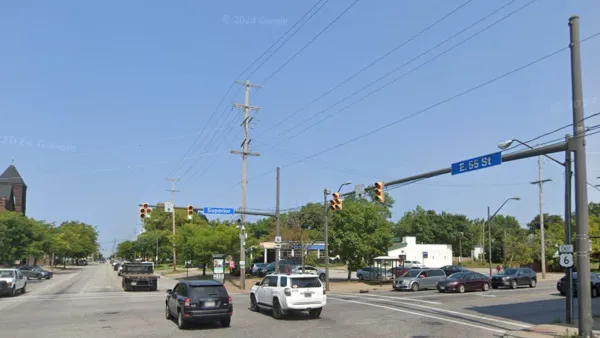
Cleveland to Boost Bike Safety With New Bike Lanes, School Programs
The program, using curriculum created by Cleveland Bikes, is part of a broader effort to improve safety along school routes.
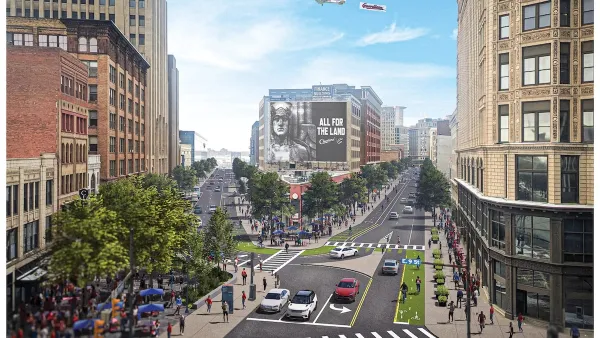
Downtown Cleveland Gets First Ever Protected Bike Lanes
The $200,000 “quick build” lanes are the first of 50 planned miles over five years.
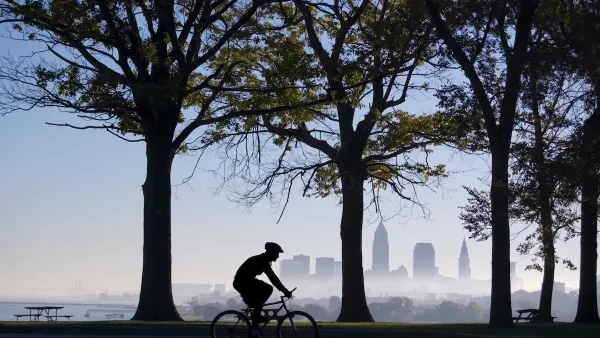
Cleveland To Build First Protected Downtown Bike Lane
The city is taking steps to build out a more comprehensive bike lane network to connect downtown destinations.

Planetizen Federal Action Tracker
A weekly monitor of how Trump’s orders and actions are impacting planners and planning in America.

Amtrak, CN end decades-long dispute with eight-year agreement
The new operating agreement establishes an updated framework for the companies to work together, including processes to resolve disputes.

Judges permit Denver to divert 77,000 acre feet from the Colorado River for reservoir expansion
Overuse and climate change have caused the Colorado River’s water levels to plummet.

South Chicago development proposal would 'upzone' neighborhoods to increase density
The South Chicago Land Use Framework plan also aims to promote pedestrian and transit-oriented developments.

Boston has spent millions making the Green Line more accessible — and there’s no end in sight
While the city has invested millions into expanding and adding platforms to the Green Line to make it more accessible, new train cars set to arrive next year will be too tall for disabled passengers to board without raising the current platforms.

Idaho may see an 18% drop in federal surface transit funding — the largest estimated cut in the US
Transit systems in rural communities are much more reliant on federal funding to provide their services.

FREE Course: Walkable City 1: Why Walkability?
After describing his path towards focusing on walkability as the essence of good planning, Jeff Speck marches through his five principal reasons for making more walkable places.
Reinventing Malls: Planning Alchemy—Turning Gray Fields Into Gold
The course focuses on the opportunities and imperatives that shape reinvention of mall sites.

City of Wisconsin Rapids
Harvard University Graduate School of Design
KFH Group Inc.
The Architects Foundation
University of Cincinnati Online
The Pocatello Development Authority
The Urban Renewal Agency of the City of Pocatello