Kudos are in order for the Central American nation of Costa Rica. We suspect running your country without burning fossil fuels is its own reward, however.


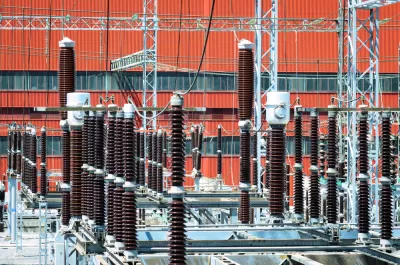
According to an article by Myles Gough, Costa Rica "has achieved a major clean energy milestone, meeting 100 percent of its power demand with renewable energy for 75 straight days."
Gough cites a press release by the Costa Rican Electricity Institute (ICE)—a state-owned power supplier.
"The ICE says the country's zero-emission milestone was enabled thanks to heavy rainfalls at four hydroelectric power facilities in the first quarter of 2015," report Gough. "These downpours have meant that, for the months of January, February and so far March, there has been no need to burn fossil fuels to generate electricity." Costa Rica also has the benefit of a mixture of geothermal, wind, biomass and solar energy.
The accomplishment comes with a few caveats, specifically that Costa Rica is a small nation of 4.8 million residents with a tourism-based economy that does not require the energy required by heavy manufacturing industries.
A separate article on the accomplishment by Sophie Vorrath notes that Costa Rica "already has an outstanding record on efficient, clean and cheap electricity generation, ranking No. 2 in Latin America for providing a household coverage rate of 99.4 per cent at some of the region’s lowest prices."
Read the full story: Costa Rica powered with 100% renewable energy for 75 straight days


Building a Just Energy Transition
A new book outlines a “four-plus pillars” framework for phasing out fossil fuels while addressing systemic inequities, emphasizing public support, dedicated funding, economic diversification, coalitions, and reforms that dismantle extractive systems.
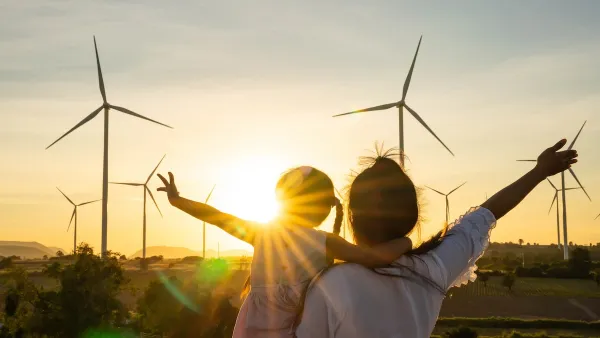
Art in Action: USC Event Calls for an Urgent Green Energy Transition
The El Respiro / Respire event at USC uses a large-scale human geochoreography to demand an urgent and equitable transition to green energy, blending art, activism, and community engagement to amplify the message of climate justice.
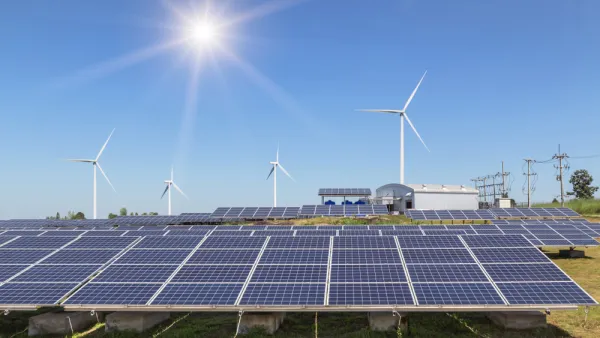
Building a Cleaner Future: Financing the Coal-to-Clean Transition
The Coal-to-Clean Initiative is an effort to fund the early retirement of coal plants in emerging markets, urging public-private collaboration to achieve a just energy transition that limits global warming and supports sustainable growth.

Planetizen Federal Action Tracker
A weekly monitor of how Trump’s orders and actions are impacting planners and planning in America.

Amtrak, CN end decades-long dispute with eight-year agreement
The new operating agreement establishes an updated framework for the companies to work together, including processes to resolve disputes.

Judges permit Denver to divert 77,000 acre feet from the Colorado River for reservoir expansion
Overuse and climate change have caused the Colorado River’s water levels to plummet.

NYC DOT wants faster, more permanent street upgrades
The city is examining ways to build more concrete infrastructure without getting entangled in 'decades-long' projects.

'Something we’ve never seen before:' rising utility rates could strain city finances nationwide
Data centers, climate change and other factors have caused utility rates in the United States to increase by 38% since 2020.

Trump to overrule local leaders, lease millions of acres of America’s Pacific Island territories’ seafloors to mining companies
International law says that the Indigenous people of America’s territories have a right to prior and informed consent regarding projects that impact their countries.

FREE Course: Walkable City 1: Why Walkability?
After describing his path towards focusing on walkability as the essence of good planning, Jeff Speck marches through his five principal reasons for making more walkable places.
Reinventing Malls: Planning Alchemy—Turning Gray Fields Into Gold
The course focuses on the opportunities and imperatives that shape reinvention of mall sites.

Harvard University Graduate School of Design
KFH Group Inc.
Greater Baltimore Committee
The Architects Foundation
University of Cincinnati Online
The Pocatello Development Authority
The Urban Renewal Agency of the City of Pocatello