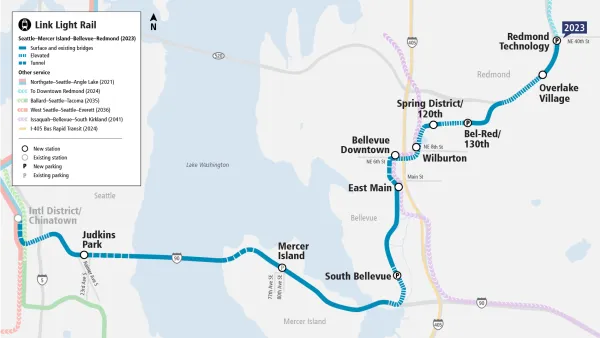
Development connected to a proposed light rail line through Mercer Island—connecting Seattle to the West and Bellevue to the East—has met staunch local opposition.


Alexa Vaughn reports on the political machinations of a group called Save Our Suburbs (SOS), advocating to slow transit oriented development along a light rail line planned for Mercer Island in the Seattle metropolitan area.
According to Vaughn, SOS is "a vocal group of at least 270 Mercer Island residents who have, since December, packed enough public meetings to urge the City Council to approve a temporary building moratorium in its Town Center district and turn down Sound Transit’s $6.3 million offer to build more park-and-ride space near the future light-rail station."
Vaughn shares the relevant details of Mercer Island's Growth Management Act, which would add 80 residential units a year through 2030. Since 1980, the population of the city held steady around 20,000 to 22,000 residents, but according to the city's latest comprehensive plan, that number is expected to rise to 26,000 by 2020.
The leaders of SOS claim that they do not oppose growth, just that they oppose "disorganized and inefficient growth." The article notes that Mercer Island Mayor Bruce Bassett is hopeful that there is plenty of space left for negotiations to get the city, SOS, and Sound Transit on the same page regarding growth, density, and transit.
Read the full story: Group pushes to restrict growth in Mercer Island’s Town Center

East Link Light Rail Plans Provoke Controversy in Seattle Suburb
A proposal to link local and regional buses with the East Link light rail expansion in Mercer Island, already under construction, threatens to boil over into the courtroom.
Seattle to Build Housing Alongside Light Rail
Seattle is going beyond transit oriented development by building apartments on parcels of land near stations.
Seattle light rail 'shatters' national ridership records with 155,000 daily rides
Sound Transit rail ridership rose sharply after the agency opened a new cross-lake connection.

Planetizen Federal Action Tracker
A weekly monitor of how Trump’s orders and actions are impacting planners and planning in America.

Amtrak, CN end decades-long dispute with eight-year agreement
The new operating agreement establishes an updated framework for the companies to work together, including processes to resolve disputes.

Judges permit Denver to divert 77,000 acre feet from the Colorado River for reservoir expansion
Overuse and climate change have caused the Colorado River’s water levels to plummet.

Boston has spent millions making the Green Line more accessible — and there’s no end in sight
While the city has invested millions into expanding and adding platforms to the Green Line to make it more accessible, new train cars set to arrive next year will be too tall for disabled passengers to board without raising the current platforms.

Idaho may see an 18% drop in federal surface transit funding — the largest estimated cut in the US
Transit systems in rural communities are much more reliant on federal funding to provide their services.

How ‘post-disaster gentrification’ alters neighborhoods after natural calamities
After hurricanes, fires or other calamities, the original residents of a community are often replaced by younger, wealthier residents.

FREE Course: Walkable City 1: Why Walkability?
After describing his path towards focusing on walkability as the essence of good planning, Jeff Speck marches through his five principal reasons for making more walkable places.
Reinventing Malls: Planning Alchemy—Turning Gray Fields Into Gold
The course focuses on the opportunities and imperatives that shape reinvention of mall sites.

City of Wisconsin Rapids
Harvard University Graduate School of Design
KFH Group Inc.
The Architects Foundation
University of Cincinnati Online
The Pocatello Development Authority
The Urban Renewal Agency of the City of Pocatello