A Supreme Court hearings less than two weeks away could destroy fair housing as we know it.


By Alan Jenkins
Open, inclusive communities free of discrimination are critical to our national success. But despite the progress we’ve made as a nation, significant obstacles to fair housing persist. There are still some real estate agents, landlords, and others who practice intentional discrimination against people of color, families with children, people with disabilities, and other Americans. But more often these days, local governments and real estate corporations engage in unjustified and unnecessary practices which have the practical effect of discriminating against people in search of housing.
In many communities, arbitrary regulations prevent the construction of affordable housing that would lead to more inclusive, integrated communities. Similarly, if a large apartment complex advertises vacancies only through word-of-mouth, the result is often that people of different races never have an opportunity to hear about or seek housing there. That means some groups of Americans are unfairly cut off from opportunities like quality schools, jobs, and business possibilities. That’s bad for us all.
Read the full story: There’s Really No Argument Against Disparate Impact


HUD Plans to Kill Key Fair Housing Rule
The department issued a proposal to eliminate the disparate impact rule, a cornerstone of some discrimination rulings under the Fair Housing Act.
Lessons in Affirmatively Furthering Fair Housing
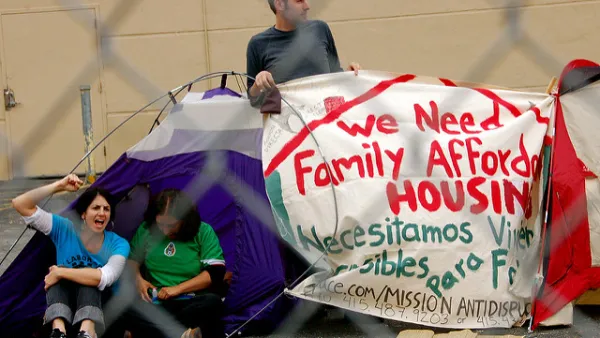
With HUD seeking comments on a revamped version of the Affirmatively Furthering fair Housing Rule, now is a good time to seek lessons from the one state to attempt to implement the federal rule at the state level.
Disparate Impact Won't Save Us From Exclusionary Zoning
The Fair Housing Act (FHA) imposes liability upon landlords and governments whose policies have a discriminatory effect against racial minorities. However, the courts have interpreted this doctrine narrowly.

Planetizen Federal Action Tracker
A weekly monitor of how Trump’s orders and actions are impacting planners and planning in America.

California plans to bury El Niño’s downpour
If the state plays its cards right, it may be able to store a billion acre-feet of El Niño’s water in aquifers.

Chicago breaks ground on $3 billion megadevelopment
The new neighborhood, titled Foundry Park, will one day host 3,700 residences.

One of Denver’s busiest corridors to gain BRT
The project will span 18 miles and contain 74 bus rapid transit stations.

275,000 bus trips are at stake on Seattle's ballot
If passed, the Seattle Transit Measure would trigger a 0.3% sales tax and raise an average of $138 million per year to maintain and expand Seattle’s bus services.

Texas may pay Israeli company billions to ease water woes
Texas awarded IDE Technologies the contract for its Harbor Island project, which is slated to become the Western Hemisphere's largest desalination plant.

FREE Course: Walkable City 1: Why Walkability?
After describing his path towards focusing on walkability as the essence of good planning, Jeff Speck marches through his five principal reasons for making more walkable places.
Reinventing Malls: Planning Alchemy—Turning Gray Fields Into Gold
The course focuses on the opportunities and imperatives that shape reinvention of mall sites.

City of Rosemead
Rutgers University, Edward J. Bloustein School of Planning and Public Policy
One Hundred Miles
Hunter College, City University of New York (CUNY)
The Architects Foundation
University of Cincinnati Online
City of Cambridge
Montrose County
The Pocatello Development Authority