A new report on millennials working in the federal government was released earlier this week by the U.S. Office of Personnel Management, detailing the trends associated with this young generation of employees.


As discussed in The Washington Post by Lisa Rein, a recent briefing by the U.S. Office of Personnel Management Director Katherine Archuleta on the 2014 Employee Viewpoint Survey highlighted some of the unique trends emerging of federal workers aged 33 and younger.
This age group of "[employees] born after 1980 now make up 16 percent of the workforce, and according to a forthcoming survey of federal employees, 86 of those who responded said their work is important. They feel their bosses treat them with respect (83 percent) and support their professional development (66 percent)... [However,] millennials tend to not stay in their jobs for long — just 3.8 years on average," writes Rein. Despite happier dispositions toward work than their older counterparts, "just one-third of the millennials surveyed believed their agencies value creativity and innovation. And only 34 percent reported that they have opportunities to advance in government."
In the press briefing, Archuleta also noted that federal millennial workers "tend to concentrate in the Department of Veterans Affairs and the Agriculture and Interior departments," and pointed out how "they are looking for work that is purpose-driven and where they think they can make a difference."
Read the full story: Millennials like government work, but don’t stay long, survey finds

Evidence-based planning in a time of information overload
The field of academic publishing has become complex and crowded. What does it mean for urban planners?

Trump administration says DC height limits don't apply to federal projects
A federal commission cleared the way for the president's proposed 250-foot arch.
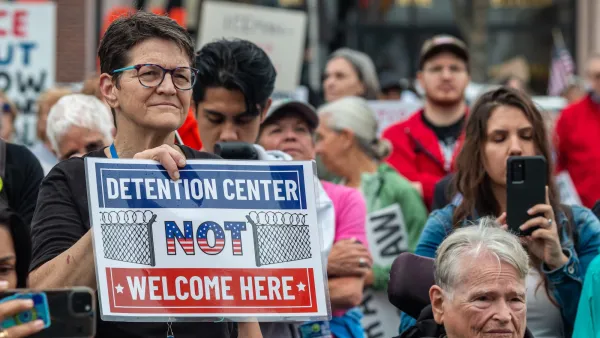
Land use as protest: How American cities are fighting federal immigration detention centers
Across the country, city officials are using zoning codes and land use law to limit where ICE detention facilities can be built.

Planetizen Federal Action Tracker
A weekly monitor of how Trump’s orders and actions are impacting planners and planning in America.

Eastern Nebraska is running out of electricity
Data centers and electrification are straining eastern Nebraska’s grid, throttling economic development.

Study reveals best places in the U.S. for cycling, walking
New research from Streetlight Data examines bicycle and pedestrian miles per capita in the 100 largest U.S. cities by population.

Next-generation nuclear reactors are coming to Texas
The reactors will not require towering containment structures thanks to new safety features.

California distributes $1.3 billion to prevent transit service cuts, bolster projects
Twenty-eight projects across California received a portion of the funding.

Pennsylvania Democrats have 15 affordability, clean energy bills for flipped state Senate
Bills in consideration include a bill supporting geothermal energy and a bill supporting solar on warehouses.

FREE Course: Walkable City 1: Why Walkability?
After describing his path towards focusing on walkability as the essence of good planning, Jeff Speck marches through his five principal reasons for making more walkable places.
Reinventing Malls: Planning Alchemy—Turning Gray Fields Into Gold
The course focuses on the opportunities and imperatives that shape reinvention of mall sites.

City of Charlotte
City of Rosemead
Rutgers University, Edward J. Bloustein School of Planning and Public Policy
University of Michigan School for Environment and Sustainability (SEAS)
Hunter College, City University of New York (CUNY)
The Architects Foundation
City of Cambridge
The Pocatello Development Authority
The Urban Renewal Agency of the City of Pocatello