One possible frame though which to consider the ongoing evolution of cities like San Francisco: the measures (sometimes) taken to preserve the historic fabric of the city.


A proposed development of a 12-story glass tower on Pine Street in San Francisco has not prompted significant opposition from neighbors, but it has provoked its own kind of controversy, according to an article on Socket City.
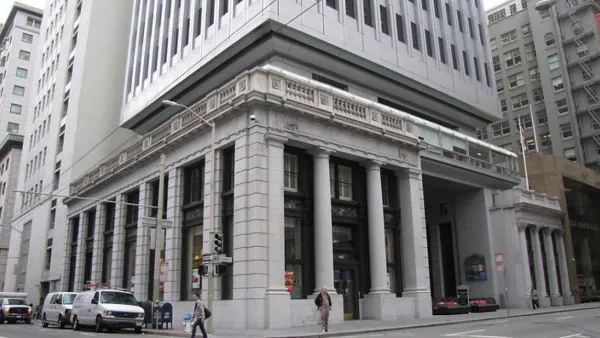
The current plan for the site is to "raze the existing garage on the site, a building that’s been deemed to be associated with 'the temporary commercial reconstruction in the aftermath of the 1906 Earthquake and Fire' and San Francisco’s historic Auto Row." Because of that historic lineage, however, "the Historic Preservation Commission would like the existing façade of the 1545 Pine Street building to be preserved and incorporated into the new development, 'to maintain the historic character of the block.'"
The HPC's recommendation for what's known as a facadectomy complicates the nature of historic preservation—and despite the neighborhood opposition, this particular iteration has inspired plenty of commentary on the Socket Site comment board. The larger concept of facadism, however, has long provided a schema for debate about the value of historic preservation, exemplified by an article by Paul Goldberger about a similar situation in 1985.
FULL STORY: A False Sense Of Preservation In SF?

Esoteric No More: Facadism Explained
Facadism is a critical concept for evaluating projects that rehabilitate, renovate, or redevelop historic structures—but it's often considered too esoteric for conversation. It's time we all got on the same page.

As prices skyrocket, San Francisco Mayor declares rent emergency
Landlords in San Francisco have initiated over 2,400 evictions since January, putting the city on track to see more evictions this year than during any year in the past decade.
Residents sue San Francisco for overriding TOD law
Advocates argue that exempting thousands of parcels from Senate Bill 79 is an "egregious example of the city flouting state law."

The state-sanctioned urbicide of Austin
People don’t kill cities. Freeways do.

US to reduce Colorado River water deliveries to Mexico
A new Colorado Treaty amendment reduces Mexico’s Colorado River water allocation by 250,000 acre feet.

New Jersey’s second-largest city bans standalone data centers
Jersey City will continue to allow co-location facilities, such as those meant for research institutions that store their own data.

Amtrak not solely to blame for New Jersey commuter rail's unreliability, report finds
A new study from the Garden State Initiative found that NJ Transit’s budget grew 20% across a 4 year period, but reliability declined significantly over the same period.

EPA erases limits on planet-warming pollution from power plants
Under Monday’s plan, power plants would still have some limits on how much mercury, arsenic and other contaminants they can emit.

Phoenix announces new on-demand transit service, more frequent RAPID buses
Both new services will launch in October, and are part of Phoenix's Project Effective Access Solutions for Easing Congestion.

FREE Course: Walkable City 1: Why Walkability?
After describing his path towards focusing on walkability as the essence of good planning, Jeff Speck marches through his five principal reasons for making more walkable places.
Reinventing Malls: Planning Alchemy—Turning Gray Fields Into Gold
The course focuses on the opportunities and imperatives that shape reinvention of mall sites.

Eagle County Government
Harvard University Graduate School of Design
Nashville Planning Department
The Architects Foundation
University of Cincinnati Online
The Pocatello Development Authority
The Urban Renewal Agency of the City of Pocatello
Journal of the American Planning Association