With support from local governments and bureaucrats, a proposal to transform the existing "M-Path" rail line into a ten-mile linear park is gaining traction in Miami. Next up: an economic impact study.


"GreenLink, a plan to create a 10-mile linear park along the southern Metrorail route, is gaining attention and support and moving ahead with the help of the University of Miami," reports John Charles Robbins.
The University of Miami will complete an economic impact study for the project of the renovation of the M-Path, but according to Robbins, the project has garnered a lot of institutional support at this point in the process. "The proposed renovation of the M-Path for bicycles and pedestrians along US 1, GreenLink is being promoted by various county agencies, including the Miami-Dade County parks and transit departments. The idea to use the underutilized land came from Friends of the GreenLink founder Meg Daly." Also, "Several municipalities have endorsed the proposal including the City of Miami, the City of Coral Gables, the City of South Miami and the Village of Pinecrest."
Robbins also covered the plans to turn the land under the rail line into a park back in June.
Read the full story: 10-mile linear park gets new look
Revealed: James Corner Field Operations Designs of the 'Underline' in Miami
After transforming opinions about public space with the High Line in New York, James Corner Field Operations will shift focus below the tracks—the Underline park under the MetroRail line in Miami.
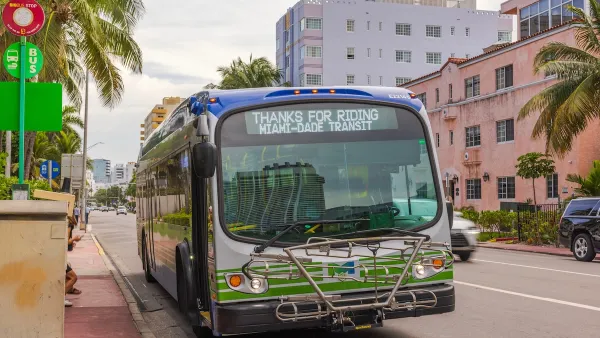
More money, less service: Miami-Dade slashes bus routes after hiking fare
The department is facing a multi-million dollar funding gap.

Miami Study to Connect Bikers and Pedestrians to Transit
The Transportation Planning Organization will budget a study on how best to connect trails to transit hubs.

Planetizen Federal Action Tracker
A weekly monitor of how Trump’s orders and actions are impacting planners and planning in America.

California plans to bury El Niño’s downpour
If the state plays its cards right, it may be able to store a billion acre-feet of El Niño’s water in aquifers.

Desperate measures: Advocates weigh draining Lake Powell to fill Colorado River
Draining the reservoir could reduce evaporation losses by a couple hundred thousand acre-feet.

Mamdani’s pied-à-terre tax survives legal challenge
A panel of judges found that the plaintiffs failed to demonstrate injury as a result of New York City's implementation of the tax.

Eastern Nebraska is running out of electricity
Data centers and electrification are straining eastern Nebraska’s grid, throttling economic development.

Seattle passes record-breaking transit services expansion
Proposition 1 will double the city’s transit tax to add 95,000 more bus trips and preserve 180,000 bus trips annually.

FREE Course: Walkable City 1: Why Walkability?
After describing his path towards focusing on walkability as the essence of good planning, Jeff Speck marches through his five principal reasons for making more walkable places.
Reinventing Malls: Planning Alchemy—Turning Gray Fields Into Gold
The course focuses on the opportunities and imperatives that shape reinvention of mall sites.

City of Rosemead
Rutgers University, Edward J. Bloustein School of Planning and Public Policy
One Hundred Miles
University of Michigan School for Environment and Sustainability (SEAS)
Hunter College, City University of New York (CUNY)
The Architects Foundation
City of Cambridge
Montrose County
The Pocatello Development Authority