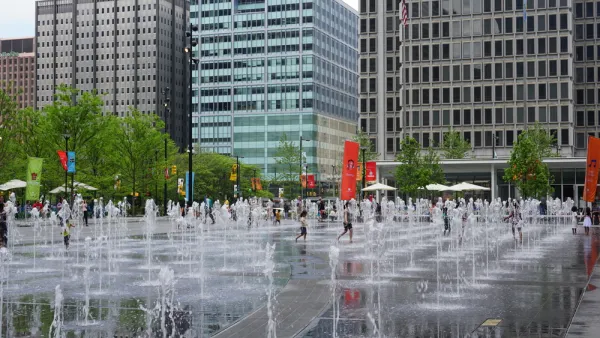
Dilworth Park, on the front door of Philadelphia's City Hall, made a splashy debut yesterday, but just as impressive as the design of the park is the work of a non-profit in achieving the grand vision for the park.


Yesterday, Philadelphia inaugurated the new Dilworth Park, described by Ryan Briggs for Next City as "a reimagined space surrounding City Hall, complete with a sweeping lawn, a cafe, fountains, public art and a new entrance to the city’s busiest transit hub."
Briggs also notes that the new park "represents one of the largest public-private partnerships undertaken in Philadelphia to date," thanks to "over a decade of work along with $55 million…on the part of CEO Paul Levy and his Center City District (CCD), an economic development non-profit created in the 1950s to channel public and private dollars into improving a then- beleaguered downtown."
The article includes a lot more detail on the work of delivering the park.
Read the full story: Philly Gets a Stunning Remake for City Hall’s Front Yard
The Reviews Are In: Philadelphia's New Dilworth Park
Calling it "a suit in a jeans-and-T-shirt world," Philadelphia Inquirer Architecture Critic Inga Saffron's review of the redesigned Dilworth Park in Philadelphia is more criticism than celebration.
Too Much Programming, Not Enough Protesting at Philadelphia's Dilworth Park
The Pulitzer Prize-winning architecture critic for the Philadelphia Inquirer raises pointed questions about the purpose of public space such as Dilworth Park, which has been absent of protests since it was remodeled two years ago.

Learning loss and urban schools, part 2
Did test scores in progressive cities drop more post-COVID than test scores in moderate ones?

Desperate measures: Advocates weigh draining Lake Powell to fill Colorado River
Draining the reservoir could reduce evaporation losses by a couple hundred thousand acre-feet.

Eastern Nebraska is running out of electricity
Data centers and electrification are straining eastern Nebraska’s grid, throttling economic development.

Move over, LA: St. Louis gears up for Olympics, invests millions in downtown redevelopment
The Missouri city will host the 2028 Olympic soccer group stage and knockout matches.

‘No clear next steps’ for Chicago's permanent festival grounds
Eleventh Ward Ald. Nicole Lee has suggested Soldier Field as a possible location for the permanent event space.

California, Hawaii, Rhode Island approve housing propositions
Hawaii and Rhode Island each approved their sole proposition, while California approved two of its three.

Officials claim feds 'rushed' Amtrak environmental review
Amtrak plans to move their Chicago maintenance facility from an industrial area to a residential one.

FREE Course: Walkable City 1: Why Walkability?
After describing his path towards focusing on walkability as the essence of good planning, Jeff Speck marches through his five principal reasons for making more walkable places.
Reinventing Malls: Planning Alchemy—Turning Gray Fields Into Gold
The course focuses on the opportunities and imperatives that shape reinvention of mall sites.

City of Rosemead
Rutgers University, Edward J. Bloustein School of Planning and Public Policy
One Hundred Miles
University of Michigan School for Environment and Sustainability (SEAS)
Hunter College, City University of New York (CUNY)
The Architects Foundation
City of Cambridge
Montrose County
The Pocatello Development Authority