A proposed ordinance currently making its way through City Hall in Los Angeles would provide a new form of enforcement for crimes such as barking dogs, loud parties, and littering—which often go unenforced under the current penal system.


Soumya Karlamangla reports on a pilot program in Los Angeles called Administrative Citation Enforcement, which "gives the LAPD and the Department of Animal Services a new enforcement tool that would bypass the court system. It would allow city officials to impose financial penalties for such offenses as urinating in public, having dogs off leashes at the beach or dumping garbage in public streets."
Rick Orlov provides additional details about the penalties that could be imposed for such offenses: "citations of $250, $500 and $1,000 for the first, second and third offenses could be issued. An administrative review process would be available should citizens choose to appeal."
Read the full story: Los Angeles City Council moves to ticket residential quality-of-life infractions

Los Angeles Metro Releases First Quality of Life Report
Metro's first Quality of Life report measures the impact of the agency's transit investments since 2008.

Los Angeles just elected an urban planner as its mayor
Transportation analysts are optimistic that Raman will be more aggressive in addressing transit issues than Bass.
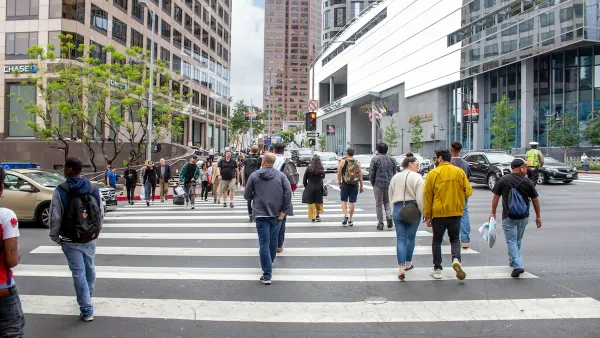
LA residents may be allowed to paint their own crosswalks
Councilwoman Katy Yaroslavsky put out a motion instructing the Los Angeles Department of Public Transportation to study the feasibility of allowing volunteers to paint crosswalks.

Desperate measures: Advocates weigh draining Lake Powell to fill Colorado River
Draining the reservoir could reduce evaporation losses by a couple hundred thousand acre-feet.

Eastern Nebraska is running out of electricity
Data centers and electrification are straining eastern Nebraska’s grid, throttling economic development.

Move over, LA: St. Louis gears up for Olympics, invests millions in downtown redevelopment
The Missouri city will host the 2028 Olympic soccer group stage and knockout matches.

‘No clear next steps’ for Chicago's permanent festival grounds
Eleventh Ward Ald. Nicole Lee has suggested Soldier Field as a possible location for the permanent event space.

California, Hawaii, Rhode Island approve housing propositions
Hawaii and Rhode Island each approved their sole proposition, while California approved two of its three.

Officials claim feds 'rushed' Amtrak environmental review
Amtrak plans to move their Chicago maintenance facility from an industrial area to a residential one.

FREE Course: Walkable City 1: Why Walkability?
After describing his path towards focusing on walkability as the essence of good planning, Jeff Speck marches through his five principal reasons for making more walkable places.
Reinventing Malls: Planning Alchemy—Turning Gray Fields Into Gold
The course focuses on the opportunities and imperatives that shape reinvention of mall sites.

City of Rosemead
Rutgers University, Edward J. Bloustein School of Planning and Public Policy
One Hundred Miles
University of Michigan School for Environment and Sustainability (SEAS)
Hunter College, City University of New York (CUNY)
The Architects Foundation
City of Cambridge
Montrose County
The Pocatello Development Authority