Suburbanites facing fines from municipalities or trying to impress their neighbors have an alternative to keep their lawns shining while still saving water—spray paint.


California's drought is no news. Three months ago, the U.S. Drought Monitor updated the condition to "exceptional" drought, after two years of little rainfall and depleted reservoir levels. However, throughout the state the urgency of water conservation is not being heard, indeed, Southern California's water consumption increased by 8 percent in May. Moreover, according to Jed Oelbaum of GOOD Magazine, "30 to 60 percent of urban fresh water is used for watering lawns (depending on the city)."
In a time where a household can be fined $500 for watering their lawn, or $500 for not watering their lawn, spray painting one's lawn seems like the only sane and viable solution. The method works by painting a non-toxic coat of sparkling green onto dead, brown grass. Costing about 23-35 cents per square foot of grass, businesses say sales of lawn coating have more than doubled within the last year.
Read the full story: Why Spray Painting Your Lawn is an Act of Patriotism

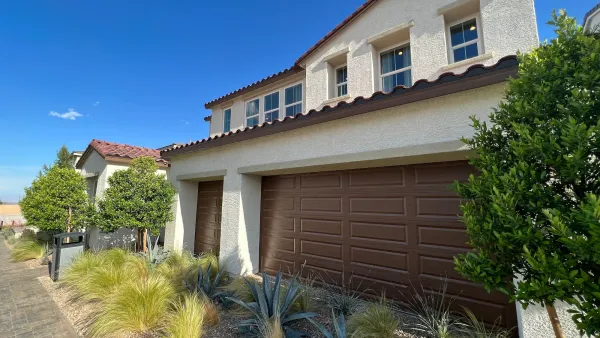
Nevada Law Requiring Removal of ‘Useless’ Grass Has Killed 100,000 Las Vegas Trees, Lawsuit Claims
The lawsuit alleges that the removal of ornamental grass has damaged the city’s tree canopy.
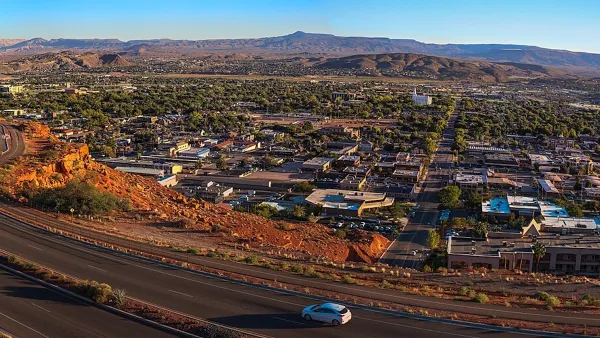
Southwest Utah Lawn ‘Buyback’ Program Pays Off
Washington County has dramatically reduced per-capita water use, but the region’s explosive growth means increased demand for water.
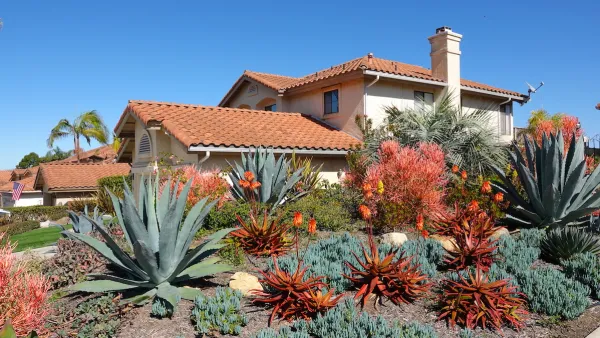
California Agency Awards $38 Million for Turf Replacement
The grant funds grass replacement rebates for commercial and residential properties and water-saving devices for fire stations.

Planetizen Federal Action Tracker
A weekly monitor of how Trump’s orders and actions are impacting planners and planning in America.

California plans to bury El Niño’s downpour
If the state plays its cards right, it may be able to store a billion acre-feet of El Niño’s water in aquifers.

Chicago breaks ground on $3 billion megadevelopment
The new neighborhood, titled Foundry Park, will one day host 3,700 residences.

California High-Speed Rail Authority CEO resigns after $600,000 scandal
Under Ian Choudri, the authority used taxpayer dollars to fund first class flights and trips to nightclubs.

Want to study the Missouri River? Soon, you may need unanimous approval from 10 states
Legislation would require 10 governors’ permission to study or build projects moving water outside the basin.

Desperate measures: Advocates weigh draining Lake Powell to fill Colorado River
Draining the reservoir could reduce evaporation losses by a couple hundred thousand acre-feet.

FREE Course: Walkable City 1: Why Walkability?
After describing his path towards focusing on walkability as the essence of good planning, Jeff Speck marches through his five principal reasons for making more walkable places.
Reinventing Malls: Planning Alchemy—Turning Gray Fields Into Gold
The course focuses on the opportunities and imperatives that shape reinvention of mall sites.

City of Rosemead
Rutgers University, Edward J. Bloustein School of Planning and Public Policy
One Hundred Miles
Hunter College, City University of New York (CUNY)
The Architects Foundation
University of Cincinnati Online
City of Cambridge
Montrose County
The Pocatello Development Authority