Philadelphia's Community Life Improvement Program is using Esri's Collector mobile app to empower their data collection in management. Prior to Collector, the anti-graffiti effort was driven by Excel.


Juliana Reyes reports that the anti graffiti team led by Philadelphia's Community Life Improvement Program (CLIP) is one month into a pilot program to test the use of a mobile app called Collector, created by Esri for use on Samsung Galaxy phones as part of its package of ArcGIS tools.
"Instead of using pen and paper to log their work out in the field, five crew members are using the ESRI-built app on Samsung Galaxy phones to track their work, complete with before and after photos," writes Reyes. If the experiment proves fruitful, the team will roll out the app to all 25 team members.
The anti-graffiti team's use of Collector is the first test for the city's soon-to-expand se of mobile data tracking in other departments. For instance, "[the] city plans to give mobile devices to inspectors from the Department of Licenses & Inspections so they can issue violations in real time, instead of waiting to go back to the office to do so."
Read the full story: Philly’s anti-graffiti team is piloting a mobile app to track its work

The future of GIS, explored
The pros and cons of ArcGIS Urban, CityEngine, AI assistants and more notes from the 2026 Esri User Conference.
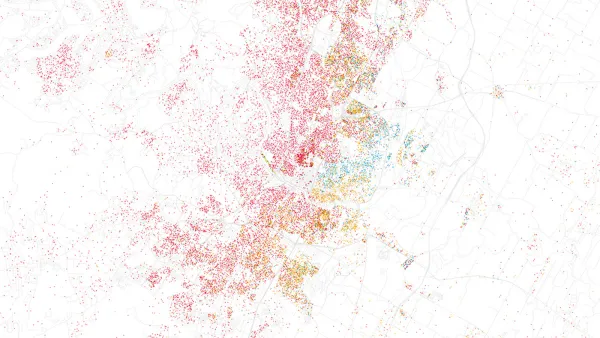
Esri App Makes Data Visualization Easy
A wealth of pre-authored policy maps lets users access data to explore public policy issues.

Philadelphia Inquirer's New App Sends 'On This Block' Alerts
The HERE app provides new ways to access information about the local arts and architecture scene.

Desperate measures: Advocates weigh draining Lake Powell to fill Colorado River
Draining the reservoir could reduce evaporation losses by a couple hundred thousand acre-feet.

Eastern Nebraska is running out of electricity
Data centers and electrification are straining eastern Nebraska’s grid, throttling economic development.

Malls are becoming the midtowns of the future
Mall and office park redevelopments are a generational opportunity to create new nodes of urbanity.

NYC breaks ground on anti-flooding infrastructure project
New York City's new system will reduce stormwater flows to local sewers by 90%.

One Kentucky town’s secret to affordable housing
The Smoketown Community Land Trust has already built seven affordable homes for community members.

Houston gains petal-shaped cooling infrastructure to make streets more ‘delightful’
The city has installed the pavilions along 15 blocks in Houston.

FREE Course: Walkable City 1: Why Walkability?
After describing his path towards focusing on walkability as the essence of good planning, Jeff Speck marches through his five principal reasons for making more walkable places.
Reinventing Malls: Planning Alchemy—Turning Gray Fields Into Gold
The course focuses on the opportunities and imperatives that shape reinvention of mall sites.

City of Rosemead
Rutgers University, Edward J. Bloustein School of Planning and Public Policy
One Hundred Miles
University of Michigan School for Environment and Sustainability (SEAS)
Hunter College, City University of New York (CUNY)
The Architects Foundation
City of Cambridge
Montrose County
The Pocatello Development Authority