It will come as no surprise to those tracking the built environment in Los Angeles that City Planning currently faces a number of challenges.


Still, the department continues to pursue a plethora of projects and initiatives. Principal City Planner Ken Bernstein provides an overview of ongoing priorities, updating readers on each one's status. He covers community planning, transit-oriented development, the Great Streets Initiative, Mobility Plan 2035, and Plan for a Healthy Los Angeles.
Addressing a major roadblock, Bernstein explains: "Last December, just as these plans were about to go to Council for final adoption, the City received the tentative decision (with the final decision in February) from the Los Angeles Superior Court striking down the Hollywood Community Plan based on perceived inadequacies in the plan’s environmental impact report... That court decision has had significant impacts and has prevented the speedy adoption of the remaining six plans. It’s meant that much of our community plan program this year is addressing the EIRs for pending plans, rather than achieving final adoption and freeing up our staff to begin new plans in other Los Angeles communities."
Despite frustrations around community planning, the department has successfully seized other opportunities. With two grants from Metro, City Planning is preparing transit-oriented development plans for neighborhoods surrounding Expo Phase II, the Westside Subway Extension, downtown rail stations, and the Orange Line in the Valley. Bernstein describes efforts to "reshape our transportation policies around the principles of 'complete streets'" through a new Mobility Plan, to update a Transportation Element dating back to the 1990s. Finally, he touches on "the city’s first-ever attempt to truly link public health and land use."
This TPR article appears as part two of two. The first segment of the interview with Bernstein, focusing on SurveyLA, can be found here.
Read the full story: Bernstein on Community Planning Slow-Down and TOD Progress

Eastern Nebraska is running out of electricity
Data centers and electrification are straining eastern Nebraska’s grid, throttling economic development.

Move over, LA: St. Louis gears up for Olympics, invests millions in downtown redevelopment
The Missouri city will host the 2028 Olympic soccer group stage and knockout matches.
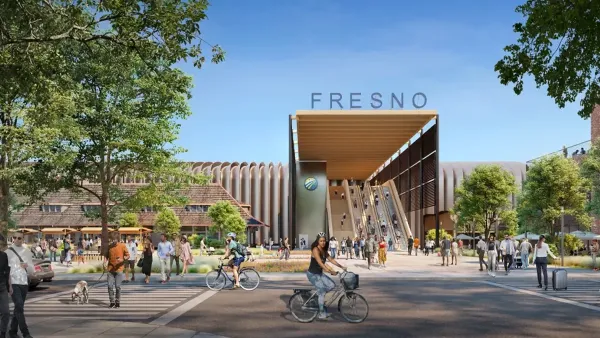
California High-Speed Rail Authority picks trainset manufacturer
The California High-Speed Rail Authority aims to start servicing passengers by 2033.

NYC renovations for dangerous, ‘mercilessly crammed’ street delayed until 2027
Construction was supposed to begin this fall.

San Diego’s Midway Rising project gets greenlight from city council
The project looks to become the largest affordable housing development in California's history.

Bill to overhaul energy permitting clears Senate
The Bipartisan American Affordability and Jobs Act of 2026 still needs to pass the House of Representatives.

FREE Course: Walkable City 1: Why Walkability?
After describing his path towards focusing on walkability as the essence of good planning, Jeff Speck marches through his five principal reasons for making more walkable places.
Reinventing Malls: Planning Alchemy—Turning Gray Fields Into Gold
The course focuses on the opportunities and imperatives that shape reinvention of mall sites.

City of Rosemead
Rutgers University, Edward J. Bloustein School of Planning and Public Policy
One Hundred Miles
University of Michigan School for Environment and Sustainability (SEAS)
Hunter College, City University of New York (CUNY)
The Architects Foundation
City of Cambridge
The Pocatello Development Authority
The Urban Renewal Agency of the City of Pocatello