French companies attempt to boost bike commutes by paying employees who cycle to work.


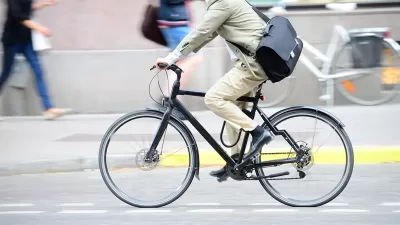
Angie Schmitt of StreetsBlog USA and Michael Graham Richard of TreeHugger summarize Reuter's post on the latest bike-to-work incentive in France. Twenty French companies comprising 10,000 employees are participating in a program that pays commuters $0.34 per biked mile to work. Per Reuters, the program expects to increase bike commute from current 2.4 percent to 3.6 percent of all work commutes. While this program is not sponsored by the government, the French Transport Ministry plans to adopt the program at a larger scale if it proves successful.
Other European countries participating in similar bike-to-work initiatives include the Netherlands, Denmark, Belgium, and Britain. Reuters lists the successful outcome of similar programs: "In Belgium, where a tax-free bike incentive scheme has been in place for more than five years, about 8 percent of all commutes are on bicycles. In the flat and bicycle-friendly Netherlands, it is about 25 percent."
Read the full story: France experiments with paying people to cycle to work

Study: Positive Psychological Effects for Walking and Biking to Work
A research study finds evidence of the positive psychological effects of walking and biking to work, joining a quickly growing body of academic research supporting multi-modal lifestyle choices.

How the ‘Big Beautiful Bill’ Impacts Transportation
Five ways the bill negatively impacts U.S. transportation policy.
Presidential Transportation Innovations
A detailed list of each U.S. president’s contributions to transportation.

Planetizen Federal Action Tracker
A weekly monitor of how Trump’s orders and actions are impacting planners and planning in America.

California plans to bury El Niño’s downpour
If the state plays its cards right, it may be able to store a billion acre-feet of El Niño’s water in aquifers.

Desperate measures: Advocates weigh draining Lake Powell to fill Colorado River
Draining the reservoir could reduce evaporation losses by a couple hundred thousand acre-feet.

California city breaks ground on transit connector
The project includes three mobility hubs and a pedestrian bridge.

After public outcry, Massachusetts city releases housing development tracker
Cambridge’s tracker currently shows 250 housing projects in various stages of development.

40 years after approval, Chicago breaks ground on new park
The park honors Jean Baptiste Point du Sable, the city’s first permanent non-native settler.

FREE Course: Walkable City 1: Why Walkability?
After describing his path towards focusing on walkability as the essence of good planning, Jeff Speck marches through his five principal reasons for making more walkable places.
Reinventing Malls: Planning Alchemy—Turning Gray Fields Into Gold
The course focuses on the opportunities and imperatives that shape reinvention of mall sites.

City of Rosemead
Rutgers University, Edward J. Bloustein School of Planning and Public Policy
One Hundred Miles
Hunter College, City University of New York (CUNY)
The Architects Foundation
University of Cincinnati Online
City of Cambridge
Montrose County
The Pocatello Development Authority