After the Seattle City Council voted to approve new small lot zoning regulations this week, the decision was hailed as a victory for neighborhood interests. The city had placed a moratorium on small lot development in September 2012.


"A majority of Seattle City Council members Monday sided with neighborhood activists and agreed to set lower height limits for homes built on small lots in single-family zones," reports Lynn Thompson. The city had a moratorium on small-lot development in place since September 2012, "after an outcry from neighbors over 30-foot-tall, modern houses on lots as small as 1,050 square feet that were permitted using obscure tax and mortgage records discovered by developers on historic, archived city maps."
"Councilmember Mike O’Brien, chair of the Land Use and Planning Committee, said that the new regulations eliminated the most extreme small-lot development and give neighbors and developers more predictability about what can be built."
"Under the new rules, no development will be permitted on lots smaller than 2,500 square feet. Many historic records can no longer be used to qualify a small lot as buildable. And neighbors will be provided notice and the right to appeal to a city hearing examiner any construction requests on lots smaller than 3,200 square feet."
"Developer advocate Roger Valdez said the new height limit of 18 feet plus a 5-foot pitched roof, or the average height of adjacent homes, whichever was greater, would only create more confusion and more issues for neighbors and the city to argue about."
Read the full story: Seattle agrees to lower height limits of new houses on small lots

Seattle Updating Zoning Regulations for Small Single-Family Lots
Planners in Seattle have responded to controversy over the size and scale of development on small lots in many of the city's single-family neighborhoods, with a new set of zoning regulations.
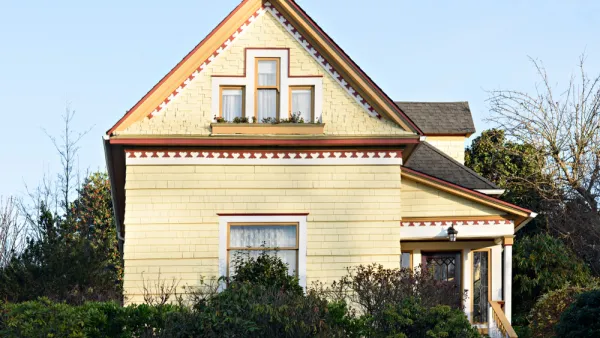
Zoned Out: Seattle Prioritizes Single-Family Residential
In Seattle, most (88 percent) of the city's new housing is being developed in a few small, already dense areas around the city. Most of the city is reserved for single-family housing.

Seattle Considering a Sweeping Parking Reform Package
There are a lot of ways to "right-size" parking, as the city of Seattle is showing with an ordinance under consideration by a City Council committee today.

Planetizen Federal Action Tracker
A weekly monitor of how Trump’s orders and actions are impacting planners and planning in America.

Amtrak, CN end decades-long dispute with eight-year agreement
The new operating agreement establishes an updated framework for the companies to work together, including processes to resolve disputes.

Judges permit Denver to divert 77,000 acre feet from the Colorado River for reservoir expansion
Overuse and climate change have caused the Colorado River’s water levels to plummet.

NYC DOT wants faster, more permanent street upgrades
The city is examining ways to build more concrete infrastructure without getting entangled in 'decades-long' projects.

'Something we’ve never seen before:' rising utility rates could strain city finances nationwide
Data centers, climate change and other factors have caused utility rates in the United States to increase by 38% since 2020.

Trump to overrule local leaders, lease millions of acres of America’s Pacific Island territories’ seafloors to mining companies
International law says that the Indigenous people of America’s territories have a right to prior and informed consent regarding projects that impact their countries.

FREE Course: Walkable City 1: Why Walkability?
After describing his path towards focusing on walkability as the essence of good planning, Jeff Speck marches through his five principal reasons for making more walkable places.
Reinventing Malls: Planning Alchemy—Turning Gray Fields Into Gold
The course focuses on the opportunities and imperatives that shape reinvention of mall sites.

Harvard University Graduate School of Design
KFH Group Inc.
Greater Baltimore Committee
The Architects Foundation
University of Cincinnati Online
The Pocatello Development Authority
The Urban Renewal Agency of the City of Pocatello