Like in many other metro areas in the country, homelessness and poverty are spreading to the suburbs in Denver. And like in other suburban areas, homelessness hides better in the suburbs, so services can be scant for a problem that is large.


Yesenia Robles examines the homelessness hiding in the Denver metro area's suburbs. "Overall, there were 11,167 homeless men, women and children counted in the 2013 point-in-time survey conducted by the Metro Denver Homeless Initiative (MDHI) across the seven-county Denver metro area," writes Robles.
Moreover, much of the homeless population is made up of families. The distressing statistics: "A county-by-county breakdown of MDHI's 2013 survey shows that families make up the largest percentage of homeless in the suburbs. In Broomfield County, the rate of families among the homeless is 85 percent; in Adams County, 80 percent; 78 percent in Douglas County; and 73 percent in Jefferson County. In Denver, just 50 percent are families with children."
The article details more characteristics of the Denver-area homeless experience as well as some of the programs at work on the problem.
Read the full story: Homeless families in suburbs not the focused priority for now
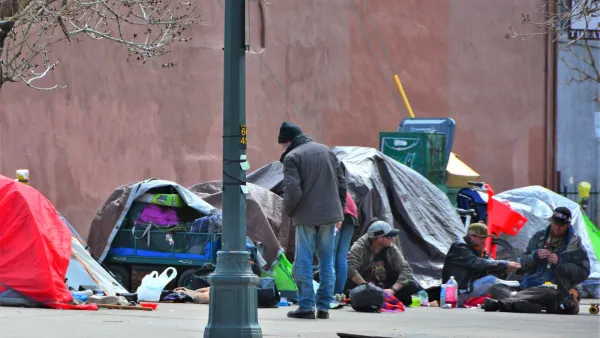
Denver Cut Unsheltered Homelessness Almost in Half Even as Unhoused Population Grows
While the total number of Denver residents without permanent housing is growing, the city has leveraged its resources to quickly create over 1,000 new emergency shelter beds.

January Must-Reads: Top 10 Articles From Last Month
How a tidal wave of potential changes at the federal level could throw many programs planners depend on into chaos, a roundup of last year’s zoning stories, and the continuing ripple effects of a landmark Supreme Court case.

Denver Announces Guaranteed Basic Income Pilot
Residents who have experienced homelessness will receive monthly cash payments to help them find and stay in stable, long-term housing.

Planetizen Federal Action Tracker
A weekly monitor of how Trump’s orders and actions are impacting planners and planning in America.

Eastern Nebraska is running out of electricity
Data centers and electrification are straining eastern Nebraska’s grid, throttling economic development.

Study reveals best places in the U.S. for cycling, walking
New research from Streetlight Data examines bicycle and pedestrian miles per capita in the 100 largest U.S. cities by population.

Next-generation nuclear reactors are coming to Texas
The reactors will not require towering containment structures thanks to new safety features.

California distributes $1.3 billion to prevent transit service cuts, bolster projects
Twenty-eight projects across California received a portion of the funding.

Pennsylvania Democrats have 15 affordability, clean energy bills for flipped state Senate
Bills in consideration include a bill supporting geothermal energy and a bill supporting solar on warehouses.

FREE Course: Walkable City 1: Why Walkability?
After describing his path towards focusing on walkability as the essence of good planning, Jeff Speck marches through his five principal reasons for making more walkable places.
Reinventing Malls: Planning Alchemy—Turning Gray Fields Into Gold
The course focuses on the opportunities and imperatives that shape reinvention of mall sites.

City of Charlotte
City of Rosemead
Rutgers University, Edward J. Bloustein School of Planning and Public Policy
University of Michigan School for Environment and Sustainability (SEAS)
Hunter College, City University of New York (CUNY)
The Architects Foundation
City of Cambridge
The Pocatello Development Authority
The Urban Renewal Agency of the City of Pocatello