Atlantic Cities has a rich history in train transportation. Recently, visitors to the Jersey Shore have benefitted in a revival of car-free options for getting to—and around—the area.


"For the last century or so, though, most Shoregoers have been traveling to the beaches from Brigantine to Cape May by car, and even the less-lazy among them often get around in their own vehicles," according to an article by Robert Strauss. But increasingly, beach towns farther south than Atlantic City are starting to add options for people to get around without their cars.
Although some of the traditional methods of getting to the shore are lost to history (according to Strauss, the Boardwalk once connected to the beach, and you can no longer "take a ride on the Reading" as the Monopoloy card says), there are plenty of cheap options for transportation—trains, buses, trolleys, and even a new jitney service. On that last option: "Over on the Boardwalk, there is a new jitney service this year with modernistic, many-windowed, 15-passenger, battery-powered vehicles that ply the boards 12 hours a day for $3 a ride (less than the $5 for the possibly more romantic rolling chairs)."
Read the full story: You Shore don't need a car at the beach these days

Black Box Showed What, but Not Why, for the New Jersey Transit Crash
The National Transportation Safety Board has determined that the minute before the Sept. 29 crash, the engineer suddenly accelerated, hurling the train into the wall of Hoboken Terminal, killing one person. They will work to find out why.
All Aboard New Jersey's Gambling Express!
New Jersey launched a new express train service, ACES, to carry visitors to the bustling Atlantic City casinos from NY Penn Station. The trip will take 2 hrs, 45 minutes. Though there won’t be gambling aboard, each train has two bars.
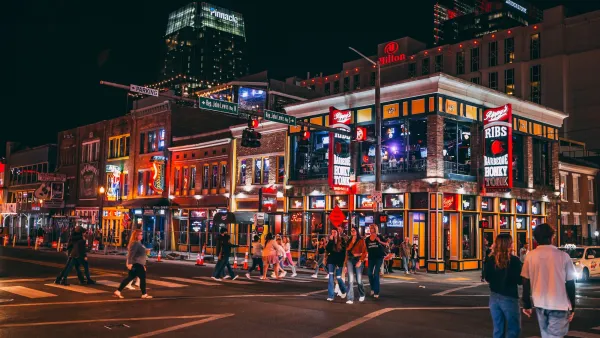
Tennessee DOT weighs making Nashville's Broadway car-free — sometimes
After a crash that killed one person and injured several others, state and city officials are in talks to consider options for closing the popular thoroughfare to cars during certain events.

Planetizen Federal Action Tracker
A weekly monitor of how Trump’s orders and actions are impacting planners and planning in America.

California plans to bury El Niño’s downpour
If the state plays its cards right, it may be able to store a billion acre-feet of El Niño’s water in aquifers.

Chicago breaks ground on $3 billion megadevelopment
The new neighborhood, titled Foundry Park, will one day host 3,700 residences.

Want to study the Missouri River? Soon, you may need unanimous approval from 10 states
Legislation would require 10 governors’ permission to study or build projects moving water outside the basin.

Desperate measures: Advocates weigh draining Lake Powell to fill Colorado River
Draining the reservoir could reduce evaporation losses by a couple hundred thousand acre-feet.

This road in NYC is infamously dangerous — and Mamdani can't fix it
New York City's Ocean Parkway is known for reckless driving, but the power to implement safety measures lies with the state rather than the city.

FREE Course: Walkable City 1: Why Walkability?
After describing his path towards focusing on walkability as the essence of good planning, Jeff Speck marches through his five principal reasons for making more walkable places.
Reinventing Malls: Planning Alchemy—Turning Gray Fields Into Gold
The course focuses on the opportunities and imperatives that shape reinvention of mall sites.

City of Rosemead
Rutgers University, Edward J. Bloustein School of Planning and Public Policy
One Hundred Miles
Hunter College, City University of New York (CUNY)
The Architects Foundation
University of Cincinnati Online
City of Cambridge
Montrose County
The Pocatello Development Authority