During the American Planning Association's (APA) 2014 National Planning Conference in Atlanta, the APA announced findings from a national opinion survey that shows a clear interest in place-making among the concerns of Americans of all ages.



"A wide-ranging national survey released today by the American Planning Association (APA) finds that Millennials and Baby Boomers want cities to focus less on recruiting new companies and more on investing in new transportation options, walkable communities, and making the area as attractive as possible," according to an APA press release announcing the poll.
Also from the press release: "If there is a single message from this poll," said APA Executive Director Paul Farmer, FAICP, "it's that place matters. Community characteristics like affordability, transportation choices, safe streets, high-speed internet and housing that can accommodate others or enable you to live there as you grow older matter as much as job opportunities."
The APA also produced a number of infographics to help drive home the point about the generational solidarity on issues like the economy and place.
Read the full story: Investing in Place: Two Generations' View on the Future of Communities

A Geography of Aging in the U.S.
Peter Rogerson crunches the numbers on 50 years of demographic shifts.

Study Finds Seniors Could Be Stuck with Unsellable Homes in the Future
A new paper predicts that home-buying trends among younger generations will lead to a flood of homes that older homeowners will not be able to sell.
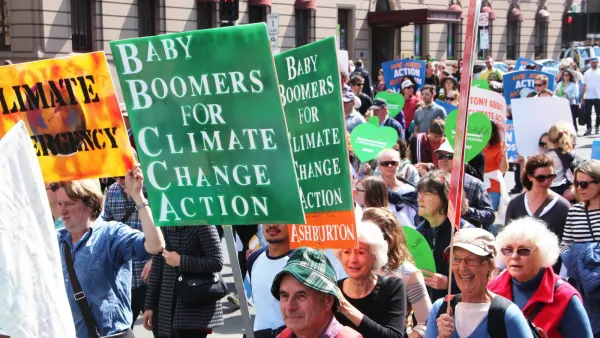
Fewer Baby Boomers Choose Urban Lifestyles Than Previous Generations
Despite appearances and a popular media narrative, Baby Boomers aren't becoming more urban in old age—when compared to previous generations at the same age.

Planetizen Federal Action Tracker
A weekly monitor of how Trump’s orders and actions are impacting planners and planning in America.

Eastern Nebraska is running out of electricity
Data centers and electrification are straining eastern Nebraska’s grid, throttling economic development.

Study reveals best places in the U.S. for cycling, walking
New research from Streetlight Data examines bicycle and pedestrian miles per capita in the 100 largest U.S. cities by population.

DSA members accuse Mamdani of 'abandoning values' over housing redevelopment
New York City's mayor plans to replace about 2,000 units of public housing with private, mixed-income housing.

All sides of BRT debate unhappy with CDOT’s most recent move
The Colorado Department of Transportation is no longer considering center-running bus lanes for Colorado Boulevard.

Massachusetts bogs generate both power, and cranberries
Putting solar panels above farmland is one way Massachusetts is advancing toward its goal of net-zero carbon emissions by 2050.

FREE Course: Walkable City 1: Why Walkability?
After describing his path towards focusing on walkability as the essence of good planning, Jeff Speck marches through his five principal reasons for making more walkable places.
Reinventing Malls: Planning Alchemy—Turning Gray Fields Into Gold
The course focuses on the opportunities and imperatives that shape reinvention of mall sites.

City of Rosemead
Rutgers University, Edward J. Bloustein School of Planning and Public Policy
One Hundred Miles
University of Michigan School for Environment and Sustainability (SEAS)
Hunter College, City University of New York (CUNY)
The Architects Foundation
City of Cambridge
The Pocatello Development Authority
The Urban Renewal Agency of the City of Pocatello