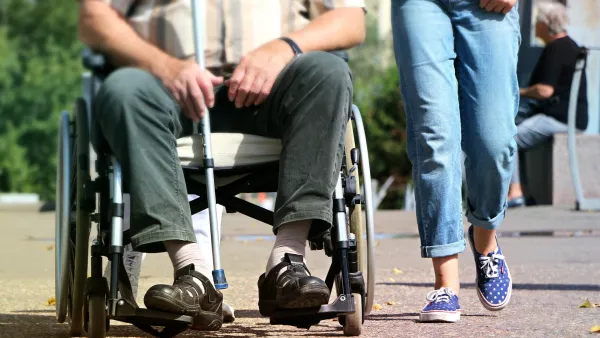
"People in the United States are getting older. But increasingly, they don't want to live in some old folks' community," writes Sarah Goodyear. As the number of Americans over 65 grows, concepts like aging in place are gaining new pertinence.


Sarah Goodyear shares news of a new study by the AARP, which explores the changing needs and desires of aging Americans, especially with regard to where they live.
"The report surveyed more than 4,500 people from a wide range of income groups, ethnicities, and types of community, and found that 71 percent of those surveyed between the ages of 50 and 64 want to continue living where they are. Eighty-seven percent of those over 65 want to remain in their current homes," writes Goodyear. Perhaps unsurprisingly, many of the study identifies commonalities between the desires of Millennials for less car-centric lifestyles and similar desires among the older generations.
The report is part of a larger AARP effort to create a "livability index" to measure how well neighborhoods meet the needs of aging populations.
Read the full story: What Does 'Livable' Mean to Older Americans?

What the Livability Index Shows About Housing
A new report highlights inequalities in accessibility and affordability.
A New 'Livability Index' to Help Americans Age in Place
Following on research findings produced a year ago, AARP announced the release of its Livability Index earlier this week at the APA National Planning Conference.

Insights From the Latest Livability Index
The latest edition of the AARP Livability Index reveals the U.S. regions with more of the kinds of neighborhoods that offer quality of life benefits for residents of all ages.

Planetizen Federal Action Tracker
A weekly monitor of how Trump’s orders and actions are impacting planners and planning in America.

California plans to bury El Niño’s downpour
If the state plays its cards right, it may be able to store a billion acre-feet of El Niño’s water in aquifers.

Chicago breaks ground on $3 billion megadevelopment
The new neighborhood, titled Foundry Park, will one day host 3,700 residences.

This road in NYC is infamously dangerous — and Mamdani can't fix it
New York City's Ocean Parkway is known for reckless driving, but the power to implement safety measures lies with the state rather than the city.

One of Denver’s busiest corridors to gain BRT
The project will span 18 miles and contain 74 bus rapid transit stations.

275,000 bus trips are at stake on Seattle's ballot
If passed, the Seattle Transit Measure would trigger a 0.3% sales tax and raise an average of $138 million per year to maintain and expand Seattle’s bus services.

FREE Course: Walkable City 1: Why Walkability?
After describing his path towards focusing on walkability as the essence of good planning, Jeff Speck marches through his five principal reasons for making more walkable places.
Reinventing Malls: Planning Alchemy—Turning Gray Fields Into Gold
The course focuses on the opportunities and imperatives that shape reinvention of mall sites.

City of Rosemead
Rutgers University, Edward J. Bloustein School of Planning and Public Policy
One Hundred Miles
Hunter College, City University of New York (CUNY)
The Architects Foundation
University of Cincinnati Online
City of Cambridge
Montrose County
The Pocatello Development Authority