A recent article details the rapid growth, evaporating surface storage capacity, and manicured lawns worsening drought conditions in Texas (no, not California).


Writing for Next City, Sara Goodyear details the facts and figures behind the under-reported story of Texas’ drought—which is approaching catastrophic levels in some parts of the state. “The drought map for the state of Texas from April 8 of this year isn’t pretty. As of the end of March, 67 percent of the state — up from 46 percent four months ago — suffered from moderate or worse drought conditions, according to the Texas Water Development Board. Twenty-five percent of the state is in ‘extreme’ drought or worse, and rainfall has been scant over the last 90 days.”
The drought has reduced levels at some of the reservoirs in the state to less than ten percent capacity. Adds Goodyear: “Not only the reservoirs are drying up. Groundwater levels are also on a downward trajectory in many parts of the state, as are stream flows — although reservoirs are particularly vulnerable because of evaporation.”
In an effort to be proactive about the drought, voters recent authorized $2 billion in water-related infrastructure spending to deal with the drought. But critics say the spending will neglect fundamental problems with the state’s management of its water supply. The first project to come online of the drought, for instance, is a surface storage facility that will send water to a suburb of the notoriously water inefficient Dallas.
Given the state’s quick population growth, Goodyear expresses concern that “the conflict between rural and urban water interests is bound to intensify if the drought continues.”
Read the full story: To Deal With Drought, Texas Needs to Manage Growth

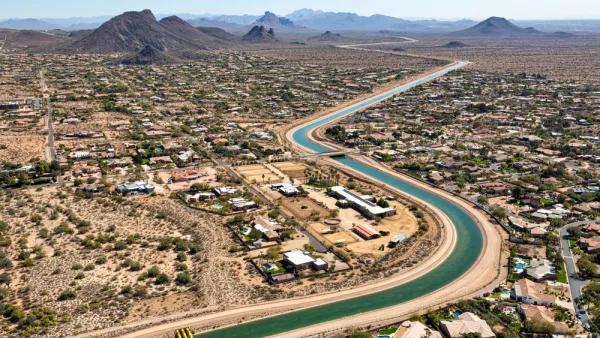
Arizona Governor Pledges $1 Billion to Water Infrastructure
The billion-dollar investment in the state's water supplies sounds good on paper, but lawmakers must also distribute funding effectively to mitigate the state's urgent water shortage.
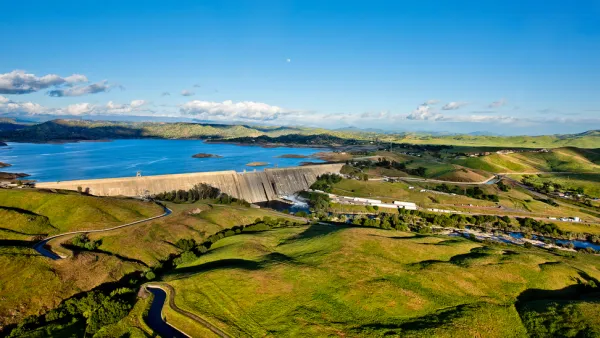
California Reservoir Project at Risk of Forfeiting $171 Million in State Funding
The Temperance Flat Reservoir Project might be falling too far behind schedule to maintain a huge chunk of state funding, according to reports.
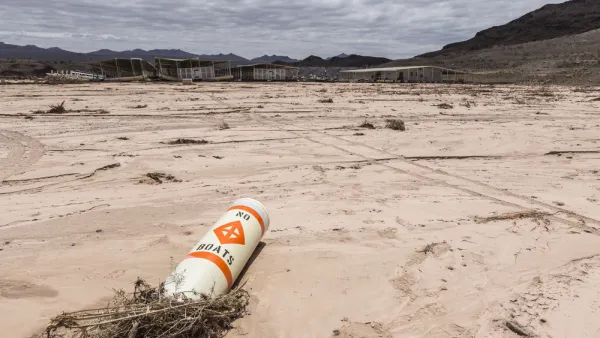
Arizona Struggles to Balance Demand for Water
Two case studies exemplify the extreme economic and legal pressures surrounding water supply in the state of Arizona.

Planetizen Federal Action Tracker
A weekly monitor of how Trump’s orders and actions are impacting planners and planning in America.

Amtrak, CN end decades-long dispute with eight-year agreement
The new operating agreement establishes an updated framework for the companies to work together, including processes to resolve disputes.

Judges permit Denver to divert 77,000 acre feet from the Colorado River for reservoir expansion
Overuse and climate change have caused the Colorado River’s water levels to plummet.

Maryland local governments examine if they should have more power to raise property taxes
Maryland’s housing market is out of reach for the majority of moderate-income residents.

Northwest rail fans eager for Sept. 30 debut of Amtrak’s Airo fleet
Get ready for that new train smell and more seats. But they won’t go faster or run more frequently on the Cascades route in Washington and Oregon.

NYC DOT wants faster, more permanent street upgrades
The city is examining ways to build more concrete infrastructure without getting entangled in 'decades-long' projects.

FREE Course: Walkable City 1: Why Walkability?
After describing his path towards focusing on walkability as the essence of good planning, Jeff Speck marches through his five principal reasons for making more walkable places.
Reinventing Malls: Planning Alchemy—Turning Gray Fields Into Gold
The course focuses on the opportunities and imperatives that shape reinvention of mall sites.

Harvard University Graduate School of Design
KFH Group Inc.
Greater Baltimore Committee
The Architects Foundation
University of Cincinnati Online
The Pocatello Development Authority
The Urban Renewal Agency of the City of Pocatello