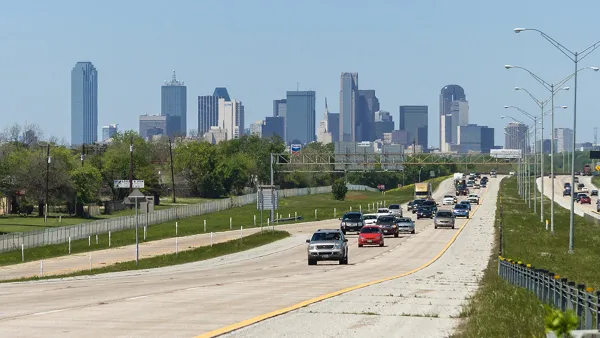
Dallas Morning News Architecture Critic Mark Lamster calls out the media for its coverage of a proposal to tear down the I-345 in Dallas.


Mark Lamster’s recent article makes an argument for reasoned debate about a plan to remove I-345, which he first reported in October of last year. “While I understand the tearout plan is controversial, and that reasonable individuals may marshal legitimate arguments against it, the kind of public discussion we need is one based on facts and reasoned discussion, not divisive misdirection.”
Lamster details the divisive misdirection as follows:
- “The first response was condescending dismissal. ‘You can usually count on crazy-town proposals to die on their own,’ wrote one columnist in this paper, incredulous that anyone might take this ‘time-waster’ seriously.”
- “[Respondents], becoming ever more desperate, have issued forth with a series of red herrings and straw men in the hopes of derailing discussion.” (The red herring, in this case, is a conspiracy theory regarding the Trinity River Toll Road.)
- “Michael Morris, the transportation director of the North Central Texas Council of Governments…saw fit to throw down the race card, baselessly suggesting that the plan’s proponents are a cabal of wealthy white folks from North Dallas with no concern (or support) from minority South Dallas.”
- There's a “fallacious supposition” inherent to a new column by Tod Robberson, “who concludes that the tearout plan would ‘make life nice and convenient for a special class of people at the expense of Dallas’s poorest and most inconvenienced.’”
Lamster also makes the point that it is, “in particular, incumbent on the plan’s proponents to make a convincing case that the tear-out plan will not be a doomsday scenario for those commuters who live in South Dallas and work in the north.”
FULL STORY: The 345 Tearout Plan Demands Reasoned Debate, Not Divisive Misdirection

What Will Become of Dallas' Interstate 345?
Disagreement about the removal of Interstate 345 in Dallas continues. Even the son of Senator Royce West wants a say in the future of the highway.
Political Power Coalesces around I-345 Teardown Proposal in Dallas
The politics of urban highways will play out in Dallas in the coming years. A new political action committee, the Coalition for a New Dallas, will push for I-345 between downtown and Deep Ellum to be torn down.
In Support of the Trinity Toll Road in Dallas
The Trinity Toll Road project in Dallas is one of the most controversial ongoing infrastructure and highway projects in the country. A Dallas Morning News columnist suggests the project's opponents should act like adults.

The state-sanctioned urbicide of Austin
People don’t kill cities. Freeways do.

US to reduce Colorado River water deliveries to Mexico
A new Colorado Treaty amendment reduces Mexico’s Colorado River water allocation by 250,000 acre feet.

New Jersey’s second-largest city bans standalone data centers
Jersey City will continue to allow co-location facilities, such as those meant for research institutions that store their own data.

Amtrak not solely to blame for New Jersey commuter rail's unreliability, report finds
A new study from the Garden State Initiative found that NJ Transit’s budget grew 20% across a 4 year period, but reliability declined significantly over the same period.

EPA erases limits on planet-warming pollution from power plants
Under Monday’s plan, power plants would still have some limits on how much mercury, arsenic and other contaminants they can emit.

Phoenix announces new on-demand transit service, more frequent RAPID buses
Both new services will launch in October, and are part of Phoenix's Project Effective Access Solutions for Easing Congestion.

FREE Course: Walkable City 1: Why Walkability?
After describing his path towards focusing on walkability as the essence of good planning, Jeff Speck marches through his five principal reasons for making more walkable places.
Reinventing Malls: Planning Alchemy—Turning Gray Fields Into Gold
The course focuses on the opportunities and imperatives that shape reinvention of mall sites.

Eagle County Government
Harvard University Graduate School of Design
Nashville Planning Department
The Architects Foundation
University of Cincinnati Online
The Pocatello Development Authority
The Urban Renewal Agency of the City of Pocatello
Journal of the American Planning Association