London's mayor, Boris Johnson, has long favoured the creation of a new airport in the Thames Estuary over expanding Heathrow. New claims of boosting house building in west London have generated further criticism.


London is short on both housing and runways and the city's mayor Boris Johnson has a 'two birds with one stone' solution: build the much desired airport capacity to London's east and the houses to the west.
The proposed airport, which would sit in the Thames Estuary, has been the focus of fierce environmental protests from it's inception and this has not changed. Darren Johnson, Green Party Member for the London Assembly, asked "[w]hat is the point of building a huge airport in the Thames Estuary flood plain and expanding the total number of flights and climate change emissions?"
The economic impacts of this proposal have been highlighed by Dr Onkar Sahota, Labour London Assembly Member for Ealing and Hillingdon, who predicted that it would "wreck west London's economy", creating "economic chaos".
The mayor disagreed stating that "the best option for increasing our aviation capacity is now to the east of London". This would free up land around Heathrow to create around 19,000 new houses, retail outlets and jobs. Another new town. Mr Johnson warned that granting permission for a third runway at Heathrow would likely be "followed by a fourth, as airlines move out of Gatwick to take up the new capacity."
A final decision on the proposal will be announced next summer.
Read the full story: 'Heathrow City' plan if airport moves from west London
Political Squabbling Trumps Demands for a New London Airport
Where are the projected 400 million air travelers coming to London supposed to land? Prime Minister David Cameron is caught between two politically difficult choices for how to manage the projected growth in passengers.
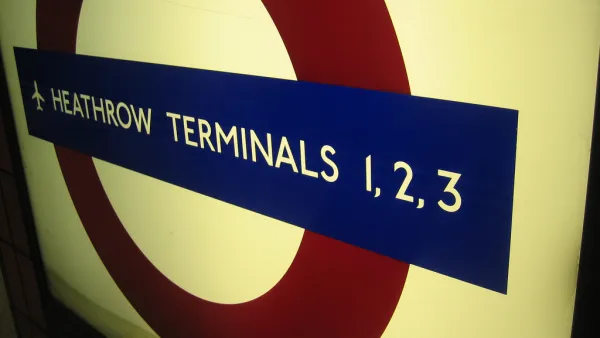
London's Mayor Takes Stand Against Airport Expansion
London Mayor Sadiq Khan has aligned himself with opponents to the addition of a third runway at London's Heathrow Airport, citing noise and air pollution concerns
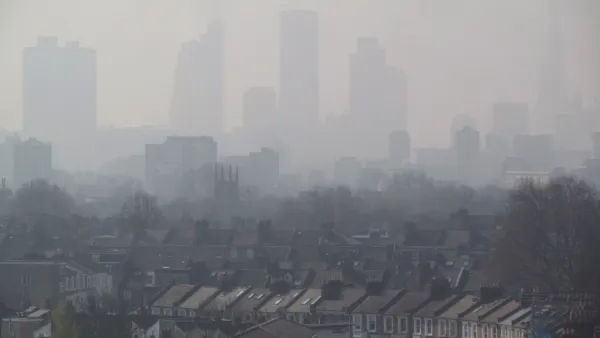
Does a Surprising Rise in Pollution Mean a Return of London's Pea-Soup Fog?
London Mayor Boris Johnson has tabled strict air-pollution controls until 2020 despite evidence of increasing pollution levels in the city's center.

Planetizen Federal Action Tracker
A weekly monitor of how Trump’s orders and actions are impacting planners and planning in America.

Eastern Nebraska is running out of electricity
Data centers and electrification are straining eastern Nebraska’s grid, throttling economic development.

Study reveals best places in the U.S. for cycling, walking
New research from Streetlight Data examines bicycle and pedestrian miles per capita in the 100 largest U.S. cities by population.

Next-generation nuclear reactors are coming to Texas
The reactors will not require towering containment structures thanks to new safety features.

California distributes $1.3 billion to prevent transit service cuts, bolster projects
Twenty-eight projects across California received a portion of the funding.

Pennsylvania Democrats have 15 affordability, clean energy bills for flipped state Senate
Bills in consideration include a bill supporting geothermal energy and a bill supporting solar on warehouses.

FREE Course: Walkable City 1: Why Walkability?
After describing his path towards focusing on walkability as the essence of good planning, Jeff Speck marches through his five principal reasons for making more walkable places.
Reinventing Malls: Planning Alchemy—Turning Gray Fields Into Gold
The course focuses on the opportunities and imperatives that shape reinvention of mall sites.

City of Charlotte
City of Rosemead
Rutgers University, Edward J. Bloustein School of Planning and Public Policy
University of Michigan School for Environment and Sustainability (SEAS)
Hunter College, City University of New York (CUNY)
The Architects Foundation
City of Cambridge
The Pocatello Development Authority
The Urban Renewal Agency of the City of Pocatello