It’s a surreal response to a surreal proposal: How many different ways can California be divided?


An artist named Bear Republic has a question for Tim Draper, the Silicon Valley businessman behind an effort to qualify an initiative for the statewide ballot that would split California into six separate states: “How can California be broken if it’s more than the sum of its parts?”
“When I first encountered the proposed ballot initiative to sever California into six separate states, I believed myself to have encountered a manner of absurdity usually reserved for April Fool’s Day,” explains Republic.
Draper’s proposal would split California into six (i.e., Silicon Valley, West California, North California, South California, Jefferson, and Central California), and although Republic says that Draper’s initiative stands a “Pinkberry’s chance in Palm Springs” of approval by voters, he decided to respond with his own project to change the public’s perspective of California.
Republic, who attended several of California’s best architecture schools but never managed to graduate, created what he calls “an avant-garde political and artistic project"—a ballot initiative that would require all visualizations (e.g., maps and infographics) of California to be rendered as a unique set of fractals, reflecting what Republic calls “the infinite and perpetually evolving manifestations of the idea-state of California.”
Republic has already begun collecting signatures, and he plans on attending both weekends of Coachella, which he believes should just about cover the 504,760 signatures required to qualify the initiative for the statewide ballot.
Read the full story: Ballot Initiative Would Split California into Fractals

How ‘Opportunity Hoarding’ Harms Communities
Wealthy communities are incorporating their own cities, draining tax revenue and resources away from surrounding neighborhoods.
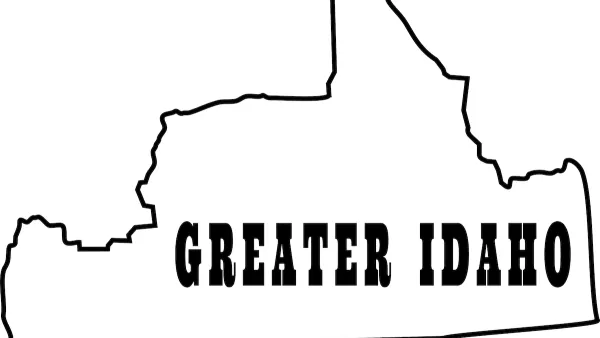
The Nation's Most Advanced Secessionist Movement
Legislation supporting the Greater Idaho Movement, which would annex over half of neighboring Oregon, has advanced in the Idaho legislature.
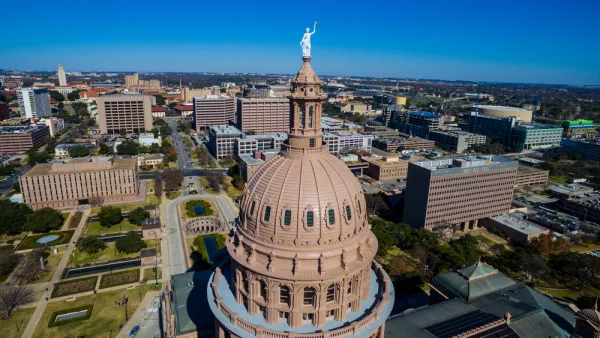
Texas Legislator Proposes ‘District of Austin’
A conservative lawmaker wants to dissolve the state’s capital city, saying officials there have ‘failed the city’ with too-liberal policies.

Planetizen Federal Action Tracker
A weekly monitor of how Trump’s orders and actions are impacting planners and planning in America.

California plans to bury El Niño’s downpour
If the state plays its cards right, it may be able to store a billion acre-feet of El Niño’s water in aquifers.

Desperate measures: Advocates weigh draining Lake Powell to fill Colorado River
Draining the reservoir could reduce evaporation losses by a couple hundred thousand acre-feet.

Los Angeles just elected an urban planner as its mayor
Transportation analysts are optimistic that Raman will be more aggressive in addressing transit issues than Bass.

Mamdani’s pied-à-terre tax survives legal challenge
A panel of judges found that the plaintiffs failed to demonstrate injury as a result of New York City's implementation of the tax.

Eastern Nebraska is running out of electricity
Data centers and electrification are straining eastern Nebraska’s grid, throttling economic development.

FREE Course: Walkable City 1: Why Walkability?
After describing his path towards focusing on walkability as the essence of good planning, Jeff Speck marches through his five principal reasons for making more walkable places.
Reinventing Malls: Planning Alchemy—Turning Gray Fields Into Gold
The course focuses on the opportunities and imperatives that shape reinvention of mall sites.

City of Rosemead
Rutgers University, Edward J. Bloustein School of Planning and Public Policy
One Hundred Miles
University of Michigan School for Environment and Sustainability (SEAS)
Hunter College, City University of New York (CUNY)
The Architects Foundation
City of Cambridge
Montrose County
The Pocatello Development Authority