Continued service to many cities in New Mexico, Colorado, and Kansas may rest with N.M. Gov. Susana Martinez who has indicated she is unwilling to share in the maintenance costs required by the federal government for a stretch of rail owned by BNSF.


What is it with Republican governors and rail transit? We've written how N.J. Gov. Chris Christie killed the replacement rail tunnels under the Hudson River, and incoming Republican governors in Wisconsin, Ohio, and Florida rejected federal high speed rail stimulus funds.
Sadly, New Mexico may be added to the list, but unlike the aforementioned rail projects, Gov. Susana Martinez' decision would also affect current service in other states serviced by the storied, long-distance Amtrak train, the Southwest Chief that runs from Los Angeles to Chicago. See Amtrak's extensive state-by-state route guide [PDF].
"A proposed partnership to bring Colorado, Kansas and New Mexico together with Amtrak and track owner Burlington Northern Santa Fe Railway to keep the train route active beyond 2015 could hinge on New Mexico Gov. Susana Martinez’s support," writes Patrick Malone.
So far, Martinez has not been keen on the idea. She has persistently said the necessary track repairs are the responsibility of the federal government, not the taxpayers of New Mexico.
The irony is not lost on Amtrak advocates. Martinez' Republican colleagues in Congress demand that Amtrak recoup more of its costs and rely less on federal subsidies.
In a hotline report, the National Association of Rail Passengers explains the reason for the cost-sharing.
The segment of the route in question is owned by Burlington Northern Santa Fe, and sees little to no freight traffic. As a result, Amtrak and the affected states are expected to pay most of the cost of maintaining the segment to permit safe operation of passenger trains at marketable speeds.
As for the other two states, Colo. Gov. John Hickenlooper supports the cost-sharing and even wants expansion. Need I mention that he's a Democrat? As for Kansas Gov. Sam Brownback, a Republican and "a staunch critic of Amtrak when he served in the U.S. Senate, his stance on the Southwest Chief has been ambiguous. But he made it clear that without funding from the other states and entities involved in the discussion, Kansas could not make it work," writes Malone.
New Mexico Rep. Luciano “Lucky” Varela, D-Santa Fe. offered one reason for Martinez to join Hickenlooper in supporting cost-sharing for the train. “It means economic development for rural areas of the state and supports tourism," he said.
Adding to the urgency of the decision, track-owner BNSF "announced it won't maintain its tracks to endure high speeds of passenger trains," according to The Denver Post.
Read the full story: Denver Post: Rail plan may hinge on N.M. governor's support
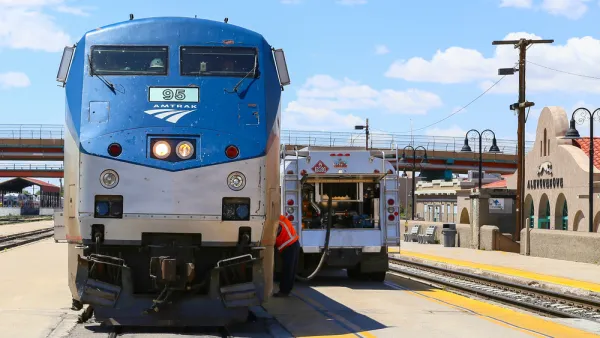
An Amtrak Train Runs Through Them
Efforts to ensure that Amtrak's Southwest Chief continues its current route through three states has united more than 20 small communities in New Mexico, Colorado, and Kansas.
Cheap Gas Takes Toll on Amtrak Ridership
McClatchy's Curtis Tate reports on Amtrak routes in Missouri and Kansas. Reduced ridership on the Missouri River Runner may be the result of falling gas prices.
Changes Ahead for Amtrak
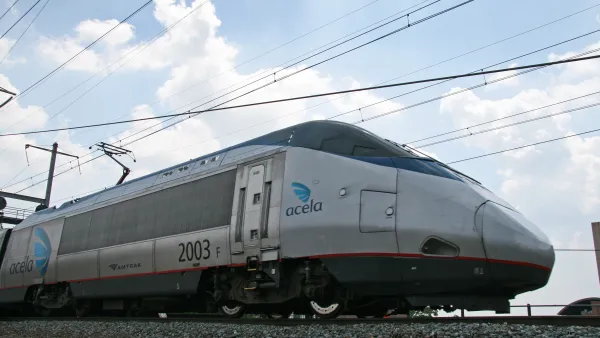
New pilot projects authorized by the FAST Act include allowing private operators to bid on operating three of Amtrak's 15 long-distance lines for up to eight years "provided they reduce the need for taxpayer support" and allowing pets on trains.

Planetizen Federal Action Tracker
A weekly monitor of how Trump’s orders and actions are impacting planners and planning in America.

Eastern Nebraska is running out of electricity
Data centers and electrification are straining eastern Nebraska’s grid, throttling economic development.

Study reveals best places in the U.S. for cycling, walking
New research from Streetlight Data examines bicycle and pedestrian miles per capita in the 100 largest U.S. cities by population.

All sides of BRT debate unhappy with CDOT’s most recent move
The Colorado Department of Transportation is no longer considering center-running bus lanes for Colorado Boulevard.

Massachusetts bogs generate both power, and cranberries
Putting solar panels above farmland is one way Massachusetts is advancing toward its goal of net-zero carbon emissions by 2050.

What could the future of LA transit look like under Raman?
The mayor-elect views broken sidewalks and potholes as crises that can be fixed with better governance.

FREE Course: Walkable City 1: Why Walkability?
After describing his path towards focusing on walkability as the essence of good planning, Jeff Speck marches through his five principal reasons for making more walkable places.
Reinventing Malls: Planning Alchemy—Turning Gray Fields Into Gold
The course focuses on the opportunities and imperatives that shape reinvention of mall sites.

City of Rosemead
Rutgers University, Edward J. Bloustein School of Planning and Public Policy
One Hundred Miles
University of Michigan School for Environment and Sustainability (SEAS)
Hunter College, City University of New York (CUNY)
The Architects Foundation
City of Cambridge
The Pocatello Development Authority
The Urban Renewal Agency of the City of Pocatello