Although it’s already been dealt one parliamentary setback, the “Anti-Social Behaviour, Crime and Policing Bill” is still under consideration in the U.K. Critics are concerned that, if the law passes, there will be no true public space left.


Although the idea of banning certain people or activities from public space is common practice in the United States, the United Kingdom has thus far managed to avoid such draconian measures for the regulation of its publicly owned spaces. Parliament, however, is currently considering a law that “greatly expands powers for state authorities to control who can do what in public space,” writes Josie Appleton.
The law experienced a setback earlier this month, when the Lords rejected parts of the law, but opposition groups are still concerned that the remainder of the bill might pass. Appleton voices their concerns: “When the Anti-Social Behaviour, Crime and Policing Bill becomes law in a few weeks, we can say that there is no longer such a thing as public space proper in Britain.”
Appleton details some of the powers made possible by the new law:
—“‘Injunctions for the Prevention of Nuisance and Annoyance’ under which anybody whose activity could cause ‘nuisance and annoyance’ to ‘any other person’ can be issued with an injunction prohibiting them from this activity or imposing positive conditions upon them. This ‘annoyance’ definition is so broad that it could catch most things people do in public space – after all, busking, preaching, protesting, wearing certain clothes, singing etc, all annoy somebody.”
—“‘Public Space Protection Orders’ (PSPOs) will mean that local authorities can ban activities which they believe have a ‘detrimental effect’ on the ‘quality of life’ of the area. Again, this could catch almost anything…Worse, it is a summary power meaning the authority doesn’t have to consult the public and can be targeted at particular groups.”
Read the full story: The End of Public Space: One Law to Ban Them All


Historic Queens park is getting a $120M upgrade
The borough's largest park will undergo significant upgrades for accessibility, flood mitigation and historic preservation.
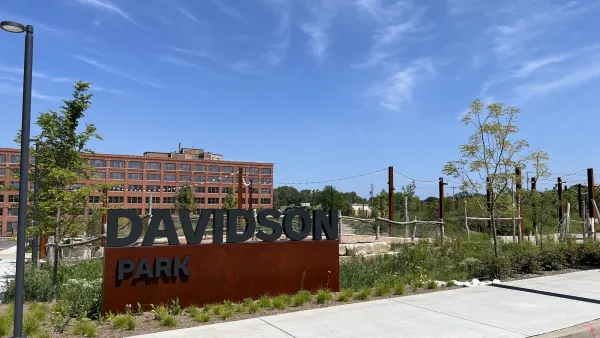
Harley-Davidson turned a Milwaukee parking lot into a green oasis
The park, adjacent to Harley-Davidson headquarters, doubles as stormwater retention infrastructure.

Planning for Love, Part 3: Enhancing human connection through walkability
In the third and final installment of this series, author Hannah Kosoff examines what her research findings say about modern dating and urban form.

Planetizen Federal Action Tracker
A weekly monitor of how Trump’s orders and actions are impacting planners and planning in America.

‘Going backwards:’ Baltimore mayor, students rally against state's transit funding plan
Maryland's proposed six-year plan provides no funding for Baltimore’s BMORE bus program and reduces its road maintenance funding.

Detroit to transform waterfront with $2.2 billion investment
Developers will convert about 18 acres of unused parking lot space into civic spaces.

U.S.-Iran war may have ‘devastating’ impact on cost to warm homes
Vermont and Maine residents may see a 76% increase in the cost of warming their homes this winter.

Senate bill would ‘overhaul’ environmental permitting laws
Under the proposed act, government agencies would also not be able to suspend or rescind permits after granting them.

Exemption applications for NYC’s pied-à-terre tax see 55% success rate
The city sent nearly 40% of its initial pied-à-terre tax warnings erroneously.

FREE Course: Walkable City 1: Why Walkability?
After describing his path towards focusing on walkability as the essence of good planning, Jeff Speck marches through his five principal reasons for making more walkable places.
Reinventing Malls: Planning Alchemy—Turning Gray Fields Into Gold
The course focuses on the opportunities and imperatives that shape reinvention of mall sites.

One Hundred Miles
County of Mendocino
planning NEXT
The Architects Foundation
University of Cincinnati Online
Montrose County
Northern Illinois Transit Authority (NITA)
The Pocatello Development Authority