At America's first ever "Walking Summit", physicians, planners, developers, and community activists gathered to discuss how physical activity can help heal people and communities.


In an excerpt from the new booklet "Walking As a Way of Life: Movement for Health & Happiness" [PDF], Jay Walljasper discusses the national Walking Summit, a first of its kind event held in October in Washington D.C. where participants espoused the physical, mental, economic benefits of walking.
"The summit was convened by Kaiser Permanente and the Every Body Walk! Collaborative, which includes more than 100 business, government and nonprofit partners," he explains.
"The 2013 Walking Summit focused on how to encourage more Americans to walk, and how to make communities across the country more walkable. Scott Bricker, executive director of America Walks, a coalition of 470 organizations nationwide, joked that the ultimate goal was to make 'sitting the new smoking.' His ambitious vision for 2020 is that all Americans walk enough each day to enjoy health benefits and that all communities provide a safe, comfortable environment for people to walk."
Read the full story: A New Movement Champions Walking for Health and Happiness
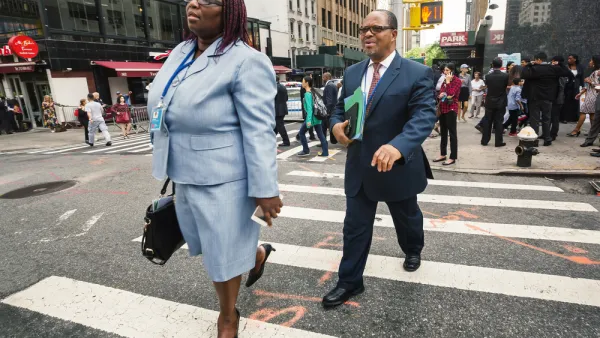
'Walking Summit' Highlights Long Path Ahead
A piece from the Congress for the New Urbanism discusses the 2017 National Walking Summit. The proceedings included the release of the nation's first walkability report card.
How Apps Can Help Track How Angelenos Move
In a review of the iPhone app Human, Los Angeles County planner Clement Lau examines how the daily movement of residents can be measured.
Healthy Community Planning - What's It Worth?
We live in a wonderful age! Scientists have proven that many simple, affordable, and often enjoyable activities make us healthier and happier: breath fresh air, avoid dangerous driving, be physically active, eat fresh fruits and vegetables, maintain friendships, play games, and avoid excessive stress. Even chocolate, red wine and sex are perscribed, in moderation, for health sake.

Washington state to charge fee to drivers with fuel-efficient cars
Revenue from the fee will go towards supporting the state’s highways.

Illinois considers spending $1 billion in taxpayer money on data center
A quantum computing campus and data center are currently under construction in Chicago.

Trump to blast ‘hydrocarbon highway’ through ‘world’s longest art gallery’
Environmental and historic preservation groups are suing to stop the project.

NYC, state sue feds over mixed-immigration-status housing assistance rule
The state’s lawsuit argues that the rule change violates the Administrative Procedure Act.

Michigan to turn neighborhood into virtual power plant
Residents will soon be able to divert their excess energy to the grid in exchange for compensation.

Data center, mining project swarm to long-awaited Alaska railroad line
The state-owned railroad approved final plans for the spur line this week; the project is expected to cost $311 million, mostly funded by the federal government

FREE Course: Walkable City 1: Why Walkability?
After describing his path towards focusing on walkability as the essence of good planning, Jeff Speck marches through his five principal reasons for making more walkable places.
Reinventing Malls: Planning Alchemy—Turning Gray Fields Into Gold
The course focuses on the opportunities and imperatives that shape reinvention of mall sites.

City of Charlotte
City of Rosemead
Rutgers University, Edward J. Bloustein School of Planning and Public Policy
University of Michigan School for Environment and Sustainability (SEAS)
Hunter College, City University of New York (CUNY)
The Architects Foundation
University District Partnership