A new report from the National Endowment for the Arts (NEA) and the U.S. Bureau of Economic Analysis (BEA) estimates the impact that all those actors, writers, and artists have on the national economy.


"Talk all you want about 'cultural capital,' but it turns out art has a real, tangible impact on the national economy," writes Bill Bradley. The "Arts and Cultural Production Satellite Account" is the first federal effort to analyze the impact of the arts and cultural sector on gross domestic product (GDP).
The BEA and NEA found that the two million people working in creative industries in 2011 "accounted for 3.2 percent — a grand total of $504 billion — of the country’s GDP," notes Bradley. "That’s more than tourism, which clocked in at 2.8 percent of the GDP."
“The positive value of arts and culture on society has been understood on a human level for millennia," said U.S. Secretary of Commerce Penny Pritzker. "With this new effort, we are now able to quantify the impact of arts and culture on GDP for the very first time."
Read the full story: Creative Work Has Real Impact On the Economy
The Emerging Arts Center of Texas
Fast Company's annual list of innovative cities highlights Dallas as an emerging hub of culture.
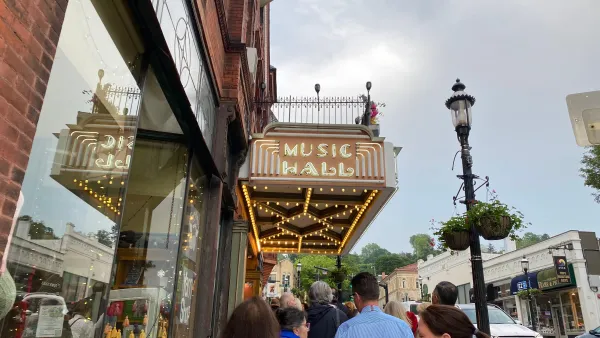
Why city hall doesn't know your music venue is a music venue (and why that matters)
Data shows that cultural venues have long lacked proper classification — which is why so many fall through the cracks.

LA is Home to a Growing Native Hawaiian Diaspora
Los Angeles has become a cultural stronghold for Native Hawaiians on the mainland, offering a sense of community, continuity, and connection for those living far from the Islands.

Planetizen Federal Action Tracker
A weekly monitor of how Trump’s orders and actions are impacting planners and planning in America.

Eastern Nebraska is running out of electricity
Data centers and electrification are straining eastern Nebraska’s grid, throttling economic development.

Study reveals best places in the U.S. for cycling, walking
New research from Streetlight Data examines bicycle and pedestrian miles per capita in the 100 largest U.S. cities by population.

Federal government nominates new FTA administrator
Mark Aesch is currently the founder and CEO of a transportation management consulting firm.

Developers reveal $10 billion stadium plan as ‘Hail Mary’ to keep Bears in Chicago
The plan would also boast a public park, high- and mid-rise buildings and a youth sports complex.

As Texas embraces carbon storage, a Black community questions the risks
Texas now issues permits for companies to store carbon dioxide underground. East Texas residents fear safety risks, and skeptics doubt the climate benefits.

FREE Course: Walkable City 1: Why Walkability?
After describing his path towards focusing on walkability as the essence of good planning, Jeff Speck marches through his five principal reasons for making more walkable places.
Reinventing Malls: Planning Alchemy—Turning Gray Fields Into Gold
The course focuses on the opportunities and imperatives that shape reinvention of mall sites.

City of Charlotte
City of Rosemead
Rutgers University, Edward J. Bloustein School of Planning and Public Policy
University of Michigan School for Environment and Sustainability (SEAS)
Hunter College, City University of New York (CUNY)
The Architects Foundation
City of Cambridge
The Pocatello Development Authority
The Urban Renewal Agency of the City of Pocatello