Population loss has been a fact of life for many of the United States' rural towns for decades. But if the experiences of rural towns across Minnesota are any indication, manufacturing, farming, and technology may generate a widespread rural revival.


"All across Minnesota, cities and towns like Osakis, once assumed to be riding a slow train to nowhere, are proving surprisingly robust," reports David Peterson. "Recoveries in agriculture and rural manufacturing are combining with rapidly spreading high-speed wireless access and other factors to yield numbers that few predicted."
“It is surprising a lot of people just how much life remains in towns once declared dead — or heading that way,” said University of Minnesota demographer Will Craig.
"Studying trends in retail, Craig and a colleague uncovered what they called 'astounding' growth in consumer sales in regional centers such as Mankato and Brainerd, and 'remarkable' increases in economic activity in many smaller communities — stiff reproofs to the 'myth of rural decline and ghost towns.'”
Read the full story: Rural revival bucks dire forecasts

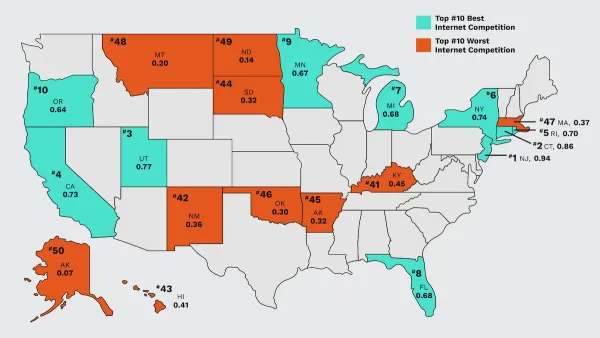
Do You Live in an ISP Monopoly?
Almost 9 million Americans live in an area with only one option for internet providers.

New Jersey Agrivoltaic Project Combines Solar Energy With Farming
A Rutgers University-New Brunswick demonstration farm will evaluate solar array designs to understand how they can best support grazing and agriculture on the same site.

New TV Series Highlights Sustainable Aquaculture
Hope in the Water explores the groundbreaking work of dedicated fishers, aqua farmers, and scientists who are seeking to harvest aquatic species to feed our growing population while protecting the oceans.

Planetizen Federal Action Tracker
A weekly monitor of how Trump’s orders and actions are impacting planners and planning in America.

California plans to bury El Niño’s downpour
If the state plays its cards right, it may be able to store a billion acre-feet of El Niño’s water in aquifers.

Chicago breaks ground on $3 billion megadevelopment
The new neighborhood, titled Foundry Park, will one day host 3,700 residences.

California High-Speed Rail Authority CEO resigns after $600,000 scandal
Under Ian Choudri, the authority used taxpayer dollars to fund first class flights and trips to nightclubs.

Want to study the Missouri River? Soon, you may need unanimous approval from 10 states
Legislation would require 10 governors’ permission to study or build projects moving water outside the basin.

Desperate measures: Advocates weigh draining Lake Powell to fill Colorado River
Draining the reservoir could reduce evaporation losses by a couple hundred thousand acre-feet.

FREE Course: Walkable City 1: Why Walkability?
After describing his path towards focusing on walkability as the essence of good planning, Jeff Speck marches through his five principal reasons for making more walkable places.
Reinventing Malls: Planning Alchemy—Turning Gray Fields Into Gold
The course focuses on the opportunities and imperatives that shape reinvention of mall sites.

City of Rosemead
Rutgers University, Edward J. Bloustein School of Planning and Public Policy
One Hundred Miles
Hunter College, City University of New York (CUNY)
The Architects Foundation
University of Cincinnati Online
City of Cambridge
Montrose County
The Pocatello Development Authority