After forty years of disinvestment in public lighting, Detroit's tens of thousands of broken street and alley lights contribute to incidents of crime and traffic accidents. Can a new lighting authority grow the city's glow?


"The thousands of inoperable streetlights in the city and miles of darkened neighborhoods and thoroughfares are some of the most visible emblems of Detroit’s mismanagement and decades-long decline," observes JC Reindl. "As many as 40% of the city’s 88,000 street and alley lights are estimated to be out. That astounding figure, adopted by Detroit emergency manager Kevyn Orr and routinely cited by national and international news media, has led to some comparisons of city services to that of a Third World country."
Reindl takes a deep look at the city's lighting crisis and its impact on city residents. Missed opportunities and redirected funds have allowed the antiquated system to languish. The latest solution, a plan "to borrow at least $150 million and upgrade the system ZIP code by ZIP code," faces uncertainty in light of the city's bankruptcy.
Read the full story: Why Detroit's lights went out, and how the city plans to get them back on

Improved Public Services a Beneficial By-Product of Detroit Bankruptcy
The addition of 50 new police cars, ramped up bus service, and long overdue streetlight repairs are all being planned as bankruptcy proceedings allow Detroit to increase funding for public services.
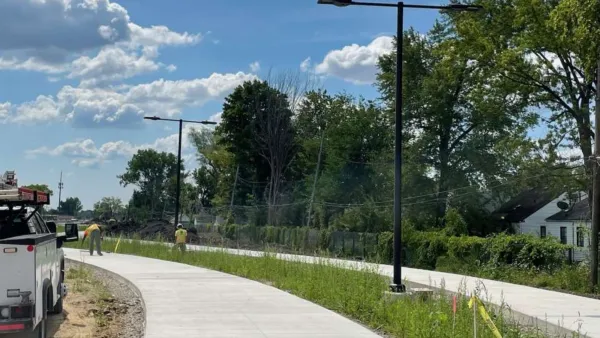
Detroit greenway brings revival — and fears of displacement
The planned Joe Louis Greenway is already bringing change to the neighborhoods near it.
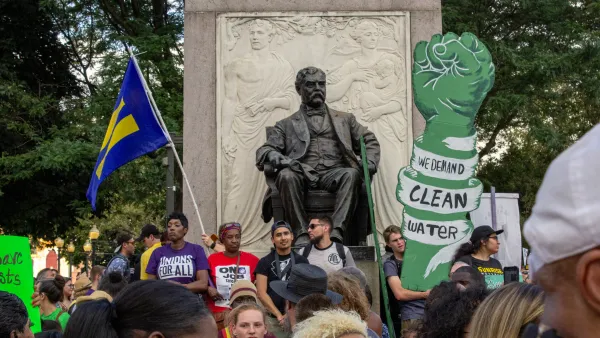
Some Detroit residents spend as much as 25% of their disposable income on water bills. A fraught history explains why.
Detroit’s water affordability crisis is tied to the uneven distribution of stormwater management costs.

Planetizen Federal Action Tracker
A weekly monitor of how Trump’s orders and actions are impacting planners and planning in America.

Amtrak, CN end decades-long dispute with eight-year agreement
The new operating agreement establishes an updated framework for the companies to work together, including processes to resolve disputes.

Judges permit Denver to divert 77,000 acre feet from the Colorado River for reservoir expansion
Overuse and climate change have caused the Colorado River’s water levels to plummet.

Philadelphia to invest $2 billion into upgrading city airports as PHL places last in customer satisfaction
Modernizations to Philadelphia's airports will include baggage system upgrades and a new automated parking garage guidance system.

The LA housing policies making developers turn away from the city
Despite LA’s housing shortage, developers say the city’s "mansion-tax" and pandemic-era policies make it an unappealing place to build housing.

New density bill would require 7 California cities to establish regional transit hubs
The bill would also require major cities in California to permit high-rise residential buildings.

FREE Course: Walkable City 1: Why Walkability?
After describing his path towards focusing on walkability as the essence of good planning, Jeff Speck marches through his five principal reasons for making more walkable places.
Reinventing Malls: Planning Alchemy—Turning Gray Fields Into Gold
The course focuses on the opportunities and imperatives that shape reinvention of mall sites.

City of Wisconsin Rapids
Harvard University Graduate School of Design
KFH Group Inc.
The Architects Foundation
University of Cincinnati Online
The Pocatello Development Authority
The Urban Renewal Agency of the City of Pocatello