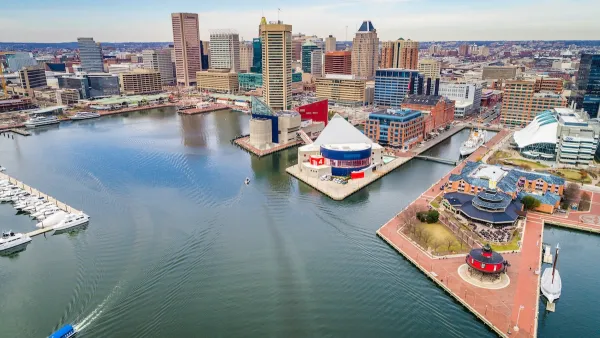
As portions of the nation's pioneering waterfront redevelopment and "festival marketplace" turn 40, Baltimore's Inner Harbor is showing its age. A new master plan for the state's premier attraction focuses on improving its public spaces.


"City leaders unveiled an ambitious long-term plan for the Inner Harbor Wednesday designed to restore pizazz to a vital area that's beginning to show its age," reports Natalie Sherman.
Concepts included in the "Inner Harbor 2.0" plan range from the incremental to the wildly ambitious - like constructing a pedestrian bridge to connect Harbor East with Federal Hill.
"The Inner Harbor, some of which turns 40 this year, needs upgrades to its crumbling brick promenades, deteriorating bulkheads and unreliable light fixtures, said Laurie Schwartz, the president of the Waterfront Partnership of Baltimore, which funded the plan along with the Greater Baltimore Committee. It also needs updates to remain a draw for local residents and the millions of people who visit the Inner Harbor each year, she said."
"It's past due time for us to take the next big look," said city planning director Thomas Stosur.
Read the full story: City unveils Inner Harbor master plan

Baltimore Invests Billions to Clean its Waterways
Like Paris, the city has been working to improve its wastewater system and make local waterways safe for swimming.
Baltimore Plans 'Floating Wetlands' to Revitalize Inner Harbor
The National Aquarium wants to recreate the tidal marshes that once lined the city's waterfront.
Enough with the Parking Garages: Baltimore's Inner Harbor Redo Criticized
The first step in the transformation of Baltimore’s Inner Harbor is a proposed renovation of Rash Field. But one commentator sees the subterranean parking garage included in conceptual plans as more of the same car-domination.

Planetizen Federal Action Tracker
A weekly monitor of how Trump’s orders and actions are impacting planners and planning in America.

The state-sanctioned urbicide of Austin
People don’t kill cities. Freeways do.

US to reduce Colorado River water deliveries to Mexico
A new Colorado Treaty amendment reduces Mexico’s Colorado River water allocation by 250,000 acre feet.

Nation's most wind-powered state turns to coal as data centers increase energy demand
For the first time in decades, Iowa has increased its generation of coal power.

NYC cools commuters with city's first rain garden above a bus stop
New York City officials say the plants in the rain garden can absorb 16 gallons of rainwater during heavy storms.

Brightline West’s future may rely on $6 billion federal loan
The company has until Nov. 2 to make a $400 million equity investment into its proposed high-speed rail line.

FREE Course: Walkable City 1: Why Walkability?
After describing his path towards focusing on walkability as the essence of good planning, Jeff Speck marches through his five principal reasons for making more walkable places.
Reinventing Malls: Planning Alchemy—Turning Gray Fields Into Gold
The course focuses on the opportunities and imperatives that shape reinvention of mall sites.

Greater Baltimore Committee
Eagle County Government
Harvard University Graduate School of Design
The Architects Foundation
University of Cincinnati Online
The Pocatello Development Authority
The Urban Renewal Agency of the City of Pocatello
Journal of the American Planning Association