Ever travel to a foreign country and gaze longingly at their sleek modern rail stock? Pardon my wandering eye, but passenger trains in the U.S. are undeniably ugly. New rules being developed by the FRA could ease the import of foreign beauties.


"For decades, the Federal Railroad Administration had effectively banned modern European trains from American mainline rail networks," writes Stephen J. Smith. "European and Asian manufacturers have been slimming down their rolling stock for years to improve performance — energy efficiency, braking and acceleration, even track and train maintenance — while U.S. transit agencies were stuck with bulked-up versions of sleek European cars, weighted down and otherwise modified to meet FRA regulations."
"But not for much longer," he continues. "Beginning in 2015, regulators and manufacturers expect the FRA to allow modern European designs on tracks throughout the country, running side by side with heavy freight at all times of day."
Read the full story: Long Barred from American Tracks, European Train Designs Could Get Rolling by 2015

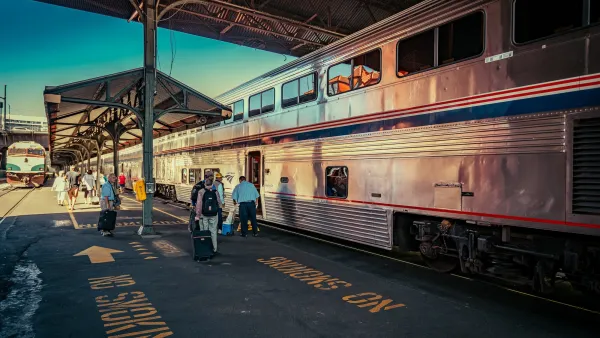
Amtrak unveils proposal to restructure, split into 3 divisions
Agency officials say the new structure would offer more transparency and accountability.
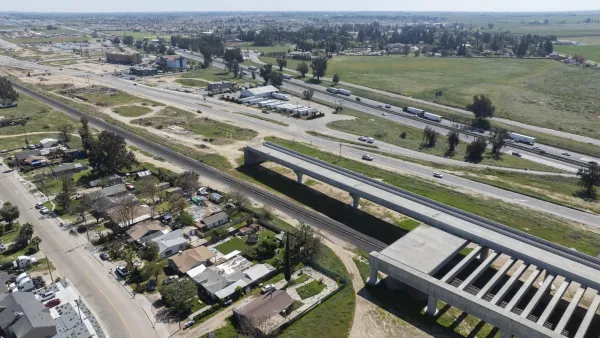
California rail builders sign MOU advancing statewide high-speed network
The agreement aims to create an interconnected high-speed rail network and bring down the cost of construction.
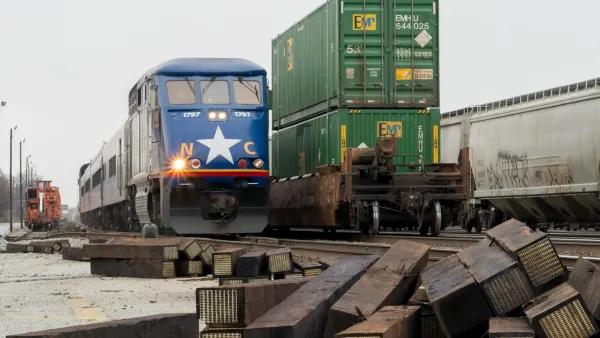
Why are America's trains so slow?
A brief historical inquiry.

Planetizen Federal Action Tracker
A weekly monitor of how Trump’s orders and actions are impacting planners and planning in America.

California plans to bury El Niño’s downpour
If the state plays its cards right, it may be able to store a billion acre-feet of El Niño’s water in aquifers.

Chicago breaks ground on $3 billion megadevelopment
The new neighborhood, titled Foundry Park, will one day host 3,700 residences.

Want to study the Missouri River? Soon, you may need unanimous approval from 10 states
Legislation would require 10 governors’ permission to study or build projects moving water outside the basin.

Desperate measures: Advocates weigh draining Lake Powell to fill Colorado River
Draining the reservoir could reduce evaporation losses by a couple hundred thousand acre-feet.

This road in NYC is infamously dangerous — and Mamdani can't fix it
New York City's Ocean Parkway is known for reckless driving, but the power to implement safety measures lies with the state rather than the city.

FREE Course: Walkable City 1: Why Walkability?
After describing his path towards focusing on walkability as the essence of good planning, Jeff Speck marches through his five principal reasons for making more walkable places.
Reinventing Malls: Planning Alchemy—Turning Gray Fields Into Gold
The course focuses on the opportunities and imperatives that shape reinvention of mall sites.

City of Rosemead
Rutgers University, Edward J. Bloustein School of Planning and Public Policy
One Hundred Miles
Hunter College, City University of New York (CUNY)
The Architects Foundation
University of Cincinnati Online
City of Cambridge
Montrose County
The Pocatello Development Authority