With urban inequality getting increased attention from politicians and pundits, many have wondered whether cities actually have the tools to address this growing challenge. A new federal initiative offers a promising solution.


"Brian Smedley, vice president and director of the Health Policy Institute at the D.C.-based Joint Center for Political and Economic Studies, sees hope for a federal response [to enduring poverty] in the Obama administration’s new Promise Zones initiative. Smedley calls Promise Zones 'the biggest, most promising anti-poverty strategy' in decades."
"Promise Zones are intended to coordinate and focus community-based programs of the Department of Housing and Urban Development (HUD), the Department of Education (DOE), the Department of Justice (DOJ) and the Department of Agriculture (DOA), on high-poverty communities across the country," explains Bernardine Watson. "The goal of Promise Zones is to accelerate these programs by using the administration’s new 'place-based' approach of integrating and aligning the resources of several federal agencies in areas of concentrated poverty."
Read the full story: Are the Obama administration’s ‘Promise Zones’ a promising anti-poverty strategy?

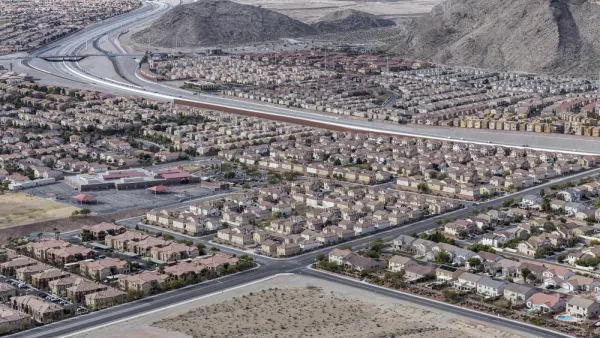
Research: Sprawl Linked to Poverty
Low-income families living in high-sprawl neighborhoods are limited in their access to education, jobs, and other amenities, often trapping them in a cycle of poverty.

Is Inequality Destroying American Cities?
A recent video claimed that high income inequality is the “Thing That Will Destroy Our Cities.” Is this true?

Rural Areas Experience Higher Food Insecurity
As pandemic-era assistance programs expire, the rate of food insecurity for rural households is rising higher than in their urban counterparts.

Planetizen Federal Action Tracker
A weekly monitor of how Trump’s orders and actions are impacting planners and planning in America.

‘Going backwards:’ Baltimore mayor, students rally against state's transit funding plan
Maryland's proposed six-year plan provides no funding for Baltimore’s BMORE bus program and reduces its road maintenance funding.

Detroit to transform waterfront with $2.2 billion investment
Developers will convert about 18 acres of unused parking lot space into civic spaces.

U.S.-Iran war may have ‘devastating’ impact on cost to warm homes
Vermont and Maine residents may see a 76% increase in the cost of warming their homes this winter.

Senate bill would ‘overhaul’ environmental permitting laws
Under the proposed act, government agencies would also not be able to suspend or rescind permits after granting them.

Exemption applications for NYC’s pied-à-terre tax see 55% success rate
The city sent nearly 40% of its initial pied-à-terre tax warnings erroneously.

FREE Course: Walkable City 1: Why Walkability?
After describing his path towards focusing on walkability as the essence of good planning, Jeff Speck marches through his five principal reasons for making more walkable places.
Reinventing Malls: Planning Alchemy—Turning Gray Fields Into Gold
The course focuses on the opportunities and imperatives that shape reinvention of mall sites.

One Hundred Miles
County of Mendocino
planning NEXT
The Architects Foundation
University of Cincinnati Online
Montrose County
Northern Illinois Transit Authority (NITA)
The Pocatello Development Authority