The NAACP is probably not the first advocacy group you think of when it comes to supporting walking and biking. But the civil rights organization encourages increasing physical activity in minority communities to help reduce childhood obesity.


"It might surprise some that the 104-year-old civil rights organization has a focus on walkable and bikeable neighborhoods," writes Tanya Snyder. "But it shouldn’t. It stems from the organization’s work on childhood obesity. Nineteen percent of black children between two and five are obese. Black high school girls are two-and-a-half times more likely to be obese than their white counterparts."
“We think of health as the premier civil rights advocacy issue,” said Niiobli Armah, the NAACP’s manager of childhood obesity for their health and wellness initiatives. “We advocate for the built environment so that students can have opportunities for safe physical activity in their neighborhoods.”
Read the full story: NAACP: A Walkable Built Environment Is a “Premier Civil Rights Issue”

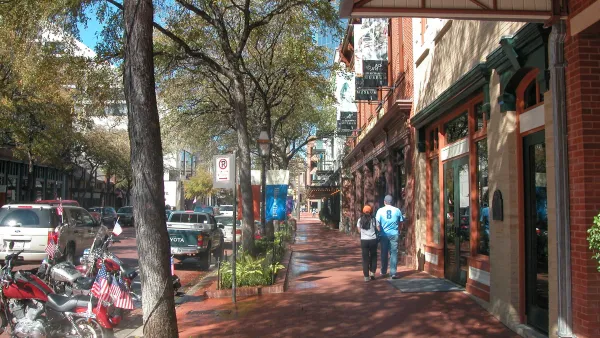
Fort Worth Wants Residents to Live Longer
The Texas city is the largest municipality so far to sign onto the Blue Zones Project, an initiative for improving longevity. In a nutshell, Blue Zones wants to make healthy choices the easy ones.
Report: Complete Streets Deliver More Than Just Good Vibes
Better safety and multimodal ease are not the only benefits offered by complete streets. According to this report, on the average they pay for themselves and then some.
Cleveland's Public Space Revolution
With new bike paths, regional trails, and renovated parks, Cleveland is catering to bikes and pedestrians, says Steven Litt. He explains how this "car town" is "undergoing a revolution in attitudes toward public space, city streets and walkability."

Planetizen Federal Action Tracker
A weekly monitor of how Trump’s orders and actions are impacting planners and planning in America.

California plans to bury El Niño’s downpour
If the state plays its cards right, it may be able to store a billion acre-feet of El Niño’s water in aquifers.

Chicago breaks ground on $3 billion megadevelopment
The new neighborhood, titled Foundry Park, will one day host 3,700 residences.

This road in NYC is infamously dangerous — and Mamdani can't fix it
New York City's Ocean Parkway is known for reckless driving, but the power to implement safety measures lies with the state rather than the city.

One of Denver’s busiest corridors to gain BRT
The project will span 18 miles and contain 74 bus rapid transit stations.

275,000 bus trips are at stake on Seattle's ballot
If passed, the Seattle Transit Measure would trigger a 0.3% sales tax and raise an average of $138 million per year to maintain and expand Seattle’s bus services.

FREE Course: Walkable City 1: Why Walkability?
After describing his path towards focusing on walkability as the essence of good planning, Jeff Speck marches through his five principal reasons for making more walkable places.
Reinventing Malls: Planning Alchemy—Turning Gray Fields Into Gold
The course focuses on the opportunities and imperatives that shape reinvention of mall sites.

City of Rosemead
Rutgers University, Edward J. Bloustein School of Planning and Public Policy
One Hundred Miles
Hunter College, City University of New York (CUNY)
The Architects Foundation
University of Cincinnati Online
City of Cambridge
Montrose County
The Pocatello Development Authority