A $1.5 billion project to provide a passenger rail link between Miami and Orlando was given a boost this week by an agreement to connect to Orlando International Airport, reached after 17 months of negotiations.


After reaching a deal with the Greater Orlando Aviation Authority, "[t]he private rail company All Aboard Florida says its [sic] on course to start a passenger rail service from Orlando to Miami by early 2016," reports Matthew Peddie. The privately owned and operated rail service, which will connect Miami and Orlando in approximately three hours, will also stop in West Palm Beach and Fort Lauderdale.
“Our service we think will certainly impact the way people travel throughout the state, but we think it will do much more than that," says All Aboard Florida president Michael Reininger. "We think it will have significant impact on the economy of central Florida as well as the state.”
Read the full story: Orlando Airport Reaches Agreement with Private Rail Company

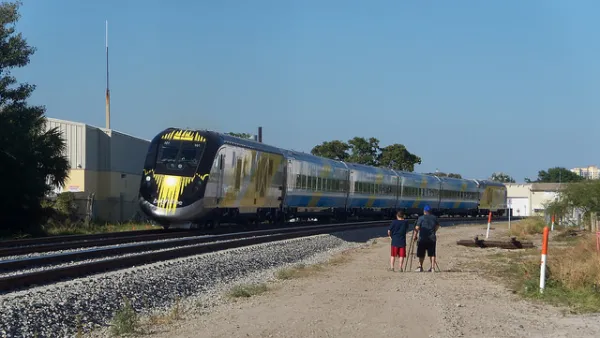
Florida's Brightline to Break Ground on Delayed Orlando Leg
The second phase of the highly anticipated Brightline express train service is finally moving forward after unanticipated delays.
Nation's Only Privately Funded Express Rail Service to Launch in July
Good and bad news for followers of Brightline, a South Florida rail start-up. Service between West Palm Beach and Fort Lauderdale begins in July, with Miami soon thereafter, but opponents may hamper extension to Orlando.
$1.75 Billion Bond Sale Delayed for All Aboard Florida
High-yield funds have less money to spend these days, leaving large infrastructure projects like the All Aboard Florida high-speed rail project waiting at the station.

Planetizen Federal Action Tracker
A weekly monitor of how Trump’s orders and actions are impacting planners and planning in America.

Amtrak, CN end decades-long dispute with eight-year agreement
The new operating agreement establishes an updated framework for the companies to work together, including processes to resolve disputes.

Judges permit Denver to divert 77,000 acre feet from the Colorado River for reservoir expansion
Overuse and climate change have caused the Colorado River’s water levels to plummet.

Northwest rail fans eager for Sept. 30 debut of Amtrak’s Airo fleet
Get ready for that new train smell and more seats. But they won’t go faster or run more frequently on the Cascades route in Washington and Oregon.

NYC DOT wants faster, more permanent street upgrades
The city is examining ways to build more concrete infrastructure without getting entangled in 'decades-long' projects.

'Something we’ve never seen before:' rising utility rates could strain city finances nationwide
Data centers, climate change and other factors have caused utility rates in the United States to increase by 38% since 2020.

FREE Course: Walkable City 1: Why Walkability?
After describing his path towards focusing on walkability as the essence of good planning, Jeff Speck marches through his five principal reasons for making more walkable places.
Reinventing Malls: Planning Alchemy—Turning Gray Fields Into Gold
The course focuses on the opportunities and imperatives that shape reinvention of mall sites.

Harvard University Graduate School of Design
KFH Group Inc.
Greater Baltimore Committee
The Architects Foundation
University of Cincinnati Online
The Pocatello Development Authority
The Urban Renewal Agency of the City of Pocatello