Before its launch, a skeptic in car-crazy L.A. might have wondered whether a pilot program to transform parking spaces into pocket parks would have much success. But, to the delight of backers, the parklets have been a hit and may expand citywide.


"A plan to increase the pedestrian friendliness of Los Angeles by blocking off parallel parking spaces and creating pocket parks on the adjacent sidewalk appears to be flourishing, according to city officials and backers of the project," writes Ann M. Simmons.
"Anastasia Loukaitou-Sideris, associate dean of the UCLA Luskin School of Public Affairs and a lead researcher at the school’s Lewis Center Complete Streets Initiative, which played an integral role in creating these new public spaces, said they seemed to be 'catching on.' More people appeared to be using the sidewalks, and the parklets were generally 'very well occupied,' she said."
Councilman Jose Huizar, who co-sponsored the pilot program, is bullish on the potential of parklets to expand citywide. "My goal is to have hundreds of [parklets] throughout the city of Los Angeles,” Huizar said. “It's a new way of thinking, a new way of adding to public amenities, to neighborhoods."
Read the full story: L.A.'s pocket parks are flourishing, supporters say
'Kit of Parts' Streamlines the Process of Converting Streets into Parks
An Atlantic Cities article details how the Los Angeles Department of Transportation’s People St program is making it easier for communities to design and build plazas, parklets, and bike facilities on their streets.
L.A. Opens its First Pilot Parklet
With the opening last weekend of the city's first pilot parklet in the neighborhood of Eagle Rock, Los Angeles is hoping to join the ranks of cities hopping on the low-cost trend in public space creation.
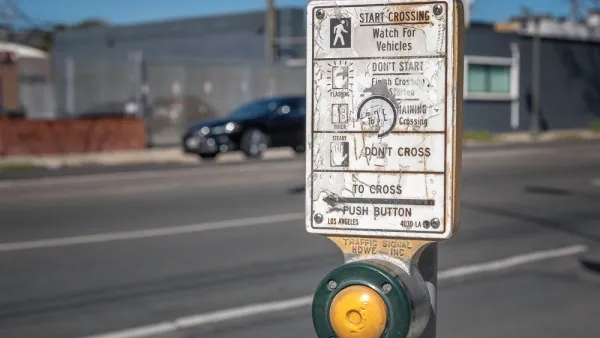
Tactical Urbanism Makes Strides in L.A.
A DIY urbanism group in Los Angeles has successfully prompted the city to install permanent crosswalks at dangerous intersections, despite the city’s insistence that the group’s do-it-yourself work is illegal.

Planetizen Federal Action Tracker
A weekly monitor of how Trump’s orders and actions are impacting planners and planning in America.

California plans to bury El Niño’s downpour
If the state plays its cards right, it may be able to store a billion acre-feet of El Niño’s water in aquifers.

Desperate measures: Advocates weigh draining Lake Powell to fill Colorado River
Draining the reservoir could reduce evaporation losses by a couple hundred thousand acre-feet.

Mamdani’s pied-à-terre tax survives legal challenge
A panel of judges found that the plaintiffs failed to demonstrate injury as a result of New York City's implementation of the tax.

Eastern Nebraska is running out of electricity
Data centers and electrification are straining eastern Nebraska’s grid, throttling economic development.

Seattle passes record-breaking transit services expansion
Proposition 1 will double the city’s transit tax to add 95,000 more bus trips and preserve 180,000 bus trips annually.

FREE Course: Walkable City 1: Why Walkability?
After describing his path towards focusing on walkability as the essence of good planning, Jeff Speck marches through his five principal reasons for making more walkable places.
Reinventing Malls: Planning Alchemy—Turning Gray Fields Into Gold
The course focuses on the opportunities and imperatives that shape reinvention of mall sites.

City of Rosemead
Rutgers University, Edward J. Bloustein School of Planning and Public Policy
One Hundred Miles
University of Michigan School for Environment and Sustainability (SEAS)
Hunter College, City University of New York (CUNY)
The Architects Foundation
City of Cambridge
Montrose County
The Pocatello Development Authority