Any visitor from America would think that Paris had found the solution to creating great public spaces and taming the automobile. But the city's new approach to urban space suggests city leaders and residents feel otherwise.


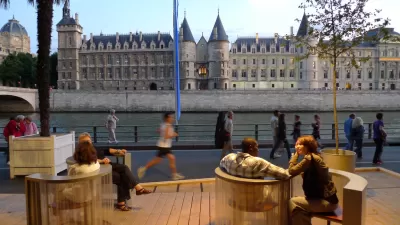
"In a 180-degree change from previous decades, during which public space was thought of mainly in terms of facilitating automobile circulation, the City of Paris has been implementing an ambitious strategy to rethink the role of the car in the city," explains Stephane Kirkland, author of Paris Reborn. "The new approach, which puts the quality of the urban experience at the heart of urban policy, has led to a complete redefinition of Paris’s urban spaces."
"The first results of this orientation are now coming to fruition, and have fundamentally changed Parisians’ experience of their city," she adds. "Automobile traffic has dropped 25% since 2002 and the level of car ownership among Parisian households has decreased to only 37%. With a conscious, large-scale shift underway in how public space is shared between cars, bicycles and pedestrians, Paris is emerging as a leader among forward-thinking cities."
Read the full story: Taking the Next Step: Paris Leads With Innovation in the Streets
Parisian Traffic, Air Pollution Reduction Plan Caught on Political Snag
Parisian clean air politics turn out to be something of a class issue, even for a socialist mayor. The plans are seen as penalizing low income Parisians while benefiting elitist city dwellers who dislike traffic, overshadowing public health benefits.
Paris Expands Big Car Reduction Plans
Paris Mayor Anne Hidalgo made a game-changing announcement in the name of clean air and walkability
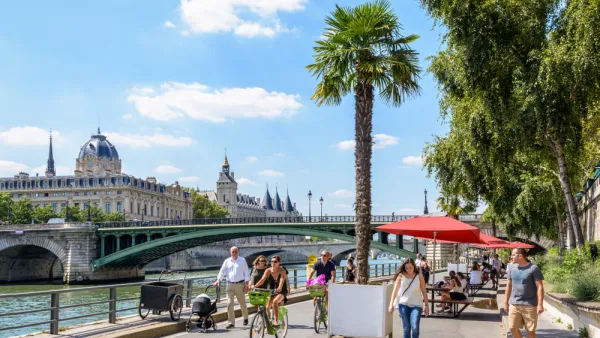
The Car-Free Revolution Continues in Paris
The city continues to reclaim space for pedestrians and cyclists.

Planetizen Federal Action Tracker
A weekly monitor of how Trump’s orders and actions are impacting planners and planning in America.

Eastern Nebraska is running out of electricity
Data centers and electrification are straining eastern Nebraska’s grid, throttling economic development.
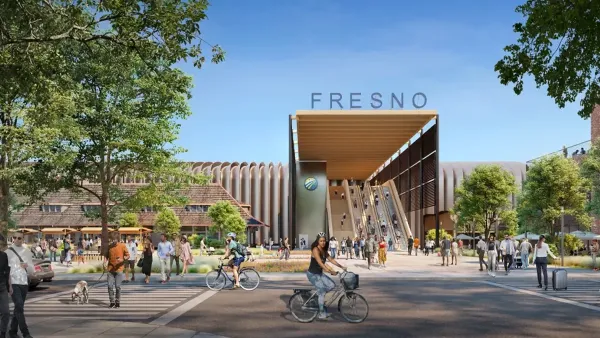
California High-Speed Rail Authority picks trainset manufacturer
The California High-Speed Rail Authority aims to start servicing passengers by 2033.

Massachusetts bogs generate both power, and cranberries
Putting solar panels above farmland is one way Massachusetts is advancing toward its goal of net-zero carbon emissions by 2050.

What could the future of LA transit look like under Raman?
The mayor-elect views broken sidewalks and potholes as crises that can be fixed with better governance.

States are counting on battery farms. Some towns don’t want them.
While fire safety has improved, some communities are still wary.

FREE Course: Walkable City 1: Why Walkability?
After describing his path towards focusing on walkability as the essence of good planning, Jeff Speck marches through his five principal reasons for making more walkable places.
Reinventing Malls: Planning Alchemy—Turning Gray Fields Into Gold
The course focuses on the opportunities and imperatives that shape reinvention of mall sites.

City of Rosemead
Rutgers University, Edward J. Bloustein School of Planning and Public Policy
One Hundred Miles
University of Michigan School for Environment and Sustainability (SEAS)
Hunter College, City University of New York (CUNY)
The Architects Foundation
City of Cambridge
The Pocatello Development Authority
The Urban Renewal Agency of the City of Pocatello