Remember those recent articles in respected national news organizations that reported a million baby boomers had moved to America's 50 largest cities between 2000 and 2010? According to Wendell Cox, they had the story backwards.


"This may be a surprising headline to readers of The Wall Street Journal and the Washington Post, which reported virtually the opposite result in their August 19 editions. . . : that 1,000,000 baby boomers moved to within five miles of the city centers of the 50 largest cities between 2000 and 2010."
"In fact, the census data shows virtually opposite," writes Cox. By querying data from the US Census using the "University of Missouri Radius Tool", he finds that "[w]ithin the five mile radius of downtown, there was a net loss of nearly 1,000,000 baby boomers, or 2 percent of the 2000 population (ages 35 to 55 in 2000). There was also a loss of 800,000 in the suburbs, or 17 percent of the 2000 population."
Mr. Cox has built a reputation as an ardent opponent of the “'return to the city from the suburbs' myth", so we'd hope a third party would conduct some unbiased analysis before one reaches any final conclusions.
Read the full story: URBAN CORE BOOMER POPULATIONS DROP 1 MILLION 2000-2010
The Counties With the Fastest Growing Population of Older Americans
The country as a whole is getting older—though some counties are aging faster than others.
Hipsters Flee as Invasion of the Baby Boomers Picks Up Speed
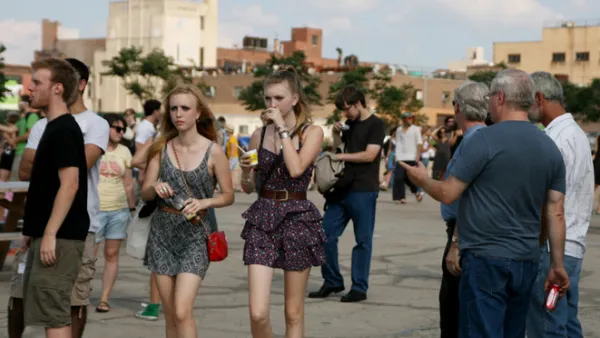
In the hip neighborhoods of Brooklyn, Seattle, and Denver, a silver tsunami is joining, and often forcing out, tattooed and mustachioed Millennials, as retiring Baby Boomers increasingly embrace urban living.
Back To The City
Babay boomers are leaving the suburbs and moving to pedestrian-friendly cities.

Planetizen Federal Action Tracker
A weekly monitor of how Trump’s orders and actions are impacting planners and planning in America.

California plans to bury El Niño’s downpour
If the state plays its cards right, it may be able to store a billion acre-feet of El Niño’s water in aquifers.

Desperate measures: Advocates weigh draining Lake Powell to fill Colorado River
Draining the reservoir could reduce evaporation losses by a couple hundred thousand acre-feet.

US buildings threatened, destroyed by fires set to triple by 2060
Researchers found a high fire risk for socioeconomically vulnerable neighborhoods in the American West.

LA residents may be allowed to paint their own crosswalks
Councilwoman Katy Yaroslavsky put out a motion instructing the Los Angeles Department of Public Transportation to study the feasibility of allowing volunteers to paint crosswalks.

Dallas moves to overhaul its zoning code
The city's zoning reform will allow more multi-family and mixed-use developments.

FREE Course: Walkable City 1: Why Walkability?
After describing his path towards focusing on walkability as the essence of good planning, Jeff Speck marches through his five principal reasons for making more walkable places.
Reinventing Malls: Planning Alchemy—Turning Gray Fields Into Gold
The course focuses on the opportunities and imperatives that shape reinvention of mall sites.

City of Rosemead
Rutgers University, Edward J. Bloustein School of Planning and Public Policy
One Hundred Miles
Hunter College, City University of New York (CUNY)
The Architects Foundation
University of Cincinnati Online
City of Cambridge
Montrose County
The Pocatello Development Authority