When voters in downtown L.A. approved a special taxing district to help fund a new $125 million streetcar line, one small detail was left out of project cost estimates - $166 million in potential utility work. Might this gap kill the project?


"Building a proposed streetcar line in downtown Los Angeles may cost more than twice the original estimate, an adjustment that raises serious questions about the project's funding and future," reports Laura J. Nelson. Utility work and other costs not included in the project's original $125 million estimate have been identified by a recent city report.
"The funding gap of almost $200 million must be resolved before officials apply for federal transportation grants, which could total up to $75 million," she adds. "The applications and the debut of the Broadway streetcar, scheduled for late 2015, will probably both be delayed."
Read the full story: Broadway streetcar faces $200-million funding gap
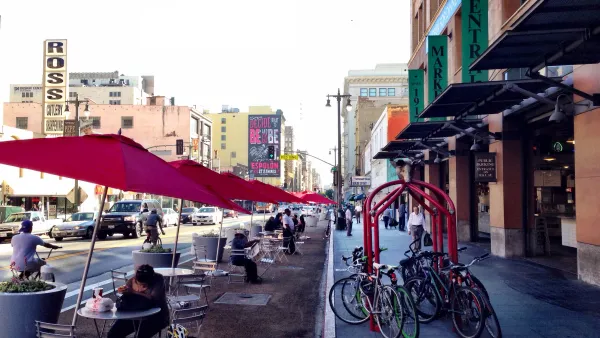
L.A. Officials to Look at Possibility of Car-Free Downtown Broadway
Los Angeles may follow in San Francisco’s footsteps by banning cars along a stretch of a downtown thoroughfare.
L.A. Streetcar Gets Go-Ahead from Voters
Voters in downtown Los Angeles have overwhelmingly approved a special property tax to help fund a $125 million streetcar. The results of the special vote-by-mail election were reported last night.
Why Downtown L.A. Should Approve a Streetcar, Despite Campaign Missteps
As a special election gets underway to determine whether 10,000 downtown L.A. residents support taxing property owners to build a new streetcar system, the editors of the Los Angeles Downtown News offer their qualified support for the project.

Planetizen Federal Action Tracker
A weekly monitor of how Trump’s orders and actions are impacting planners and planning in America.

California plans to bury El Niño’s downpour
If the state plays its cards right, it may be able to store a billion acre-feet of El Niño’s water in aquifers.

Desperate measures: Advocates weigh draining Lake Powell to fill Colorado River
Draining the reservoir could reduce evaporation losses by a couple hundred thousand acre-feet.

Los Angeles just elected an urban planner as its mayor
Transportation analysts are optimistic that Raman will be more aggressive in addressing transit issues than Bass.

Mamdani’s pied-à-terre tax survives legal challenge
A panel of judges found that the plaintiffs failed to demonstrate injury as a result of New York City's implementation of the tax.

Eastern Nebraska is running out of electricity
Data centers and electrification are straining eastern Nebraska’s grid, throttling economic development.

FREE Course: Walkable City 1: Why Walkability?
After describing his path towards focusing on walkability as the essence of good planning, Jeff Speck marches through his five principal reasons for making more walkable places.
Reinventing Malls: Planning Alchemy—Turning Gray Fields Into Gold
The course focuses on the opportunities and imperatives that shape reinvention of mall sites.

City of Rosemead
Rutgers University, Edward J. Bloustein School of Planning and Public Policy
One Hundred Miles
University of Michigan School for Environment and Sustainability (SEAS)
Hunter College, City University of New York (CUNY)
The Architects Foundation
City of Cambridge
Montrose County
The Pocatello Development Authority