New York and Los Angeles lead the U.S. with the most job openings in fields that require a college education. But these cities also have the largest pool of competitors. By applying a "location quotient", a different picture of opportunity emerges.


"[B]y using a metric called a "location quotient," or LQ for short, which shows a metro's current concentration of these fast-growing, educated jobs relative to the national average," Richard Florida and his colleagues are able to look beyond the total number of job openings to glean which cities provide graduates with the best odds of landing a job in a highly educated field.
Applying the LQ lens, it becomes clear that the country's "high-tech, knowledge economy" hubs offer the best opportunities. The San Jose metro leads the list, followed by greater Washington, D.C., Boston-Cambridge, Seattle, San Francisco-Oakland-Fremont, Raleigh-Cary, and Austin.
"The remainder of the top ten are more interesting," writes Florida. "Rounding out the bunch are Hartford, Connecticut, as well as hard-hit Detroit, Michigan, and Baltimore, Maryland. It is especially encouraging to see Detroit among the nation's leaders in job openings for talented young people. This suggests that efforts from the local business community to remake its downtown may have real legs."
Read the full story: The Best U.S. Metros for Recent College Grads Looking for Work

Texas cities and counties forgo $1 billion in taxes to data centers in exchange for few job guarantees
The Tribune found 53 local tax agreements across 34 data centers guaranteed a total of 465 jobs. Roughly half of the agreements had no job stipulations.
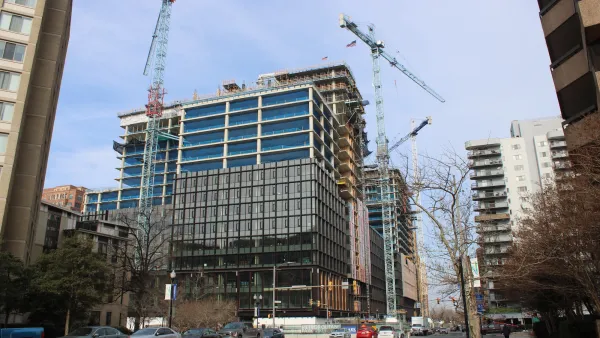
Amazon's HQ2 promised 25,000 jobs. It has created less than a third of that.
Virginia offered Amazon up to $750 million in public subsidies in exchange for creating local jobs and investment.

Data Centers Gaining Ground in Central Ohio
Massive data centers are gobbling up energy resources and tax breaks while creating few jobs in the region.

Washington state to charge fee to drivers with fuel-efficient cars
Revenue from the fee will go towards supporting the state’s highways.

Illinois considers spending $1 billion in taxpayer money on data center
A quantum computing campus and data center are currently under construction in Chicago.

Trump to blast ‘hydrocarbon highway’ through ‘world’s longest art gallery’
Environmental and historic preservation groups are suing to stop the project.

NYC, state sue feds over mixed-immigration-status housing assistance rule
The state’s lawsuit argues that the rule change violates the Administrative Procedure Act.

Michigan to turn neighborhood into virtual power plant
Residents will soon be able to divert their excess energy to the grid in exchange for compensation.

Data center, mining project swarm to long-awaited Alaska railroad line
The state-owned railroad approved final plans for the spur line this week; the project is expected to cost $311 million, mostly funded by the federal government

FREE Course: Walkable City 1: Why Walkability?
After describing his path towards focusing on walkability as the essence of good planning, Jeff Speck marches through his five principal reasons for making more walkable places.
Reinventing Malls: Planning Alchemy—Turning Gray Fields Into Gold
The course focuses on the opportunities and imperatives that shape reinvention of mall sites.

City of Charlotte
City of Rosemead
Rutgers University, Edward J. Bloustein School of Planning and Public Policy
University of Michigan School for Environment and Sustainability (SEAS)
Hunter College, City University of New York (CUNY)
The Architects Foundation
University District Partnership