Artist spends decades creating an always-growing hand-drawn paper map of an imaginary place. Development is determined by drawing a random card from a custom deck of cards.


Since 1963, Jerry Gretzinger has been drawing and painting an ever-growing paper map filled with imaginary cities, rivers, lakes, railroads, airports, highways, & farmlands. He uses a photocopier, pens, and paints and keeps track of the growing map's over 2600 "tiles" in a spreadsheet.
"Now Jerry uses a specially crafted deck of cards to determine the outcome of his world, with fictitious cities like “Plaeides,” “Wybourne” and the largest, “Ukrainia.” Each day he draws cards to see how a page of his gigantic map will be modified, with perhaps the most unusual card being the 'void.' With this card a blank spot is put on the map, wiping out previous details completely and opening up a world of new possibility. "
The map was on exhibit at the Massachusetts Museum of Contemporary Art in 2012. A zoomable version of the map is available online.
Read the full story: VisualNews

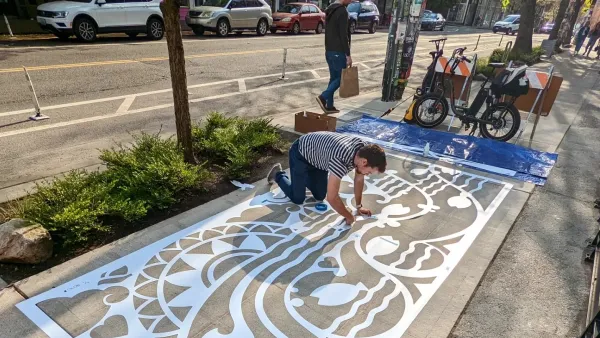
This Seattle sidewalk art only appears when it rains
Prompted to find a silver lining to the gloom of rainy Pacific Northwest days, an artist hit upon a novel solution: water-activated sidewalk paint.
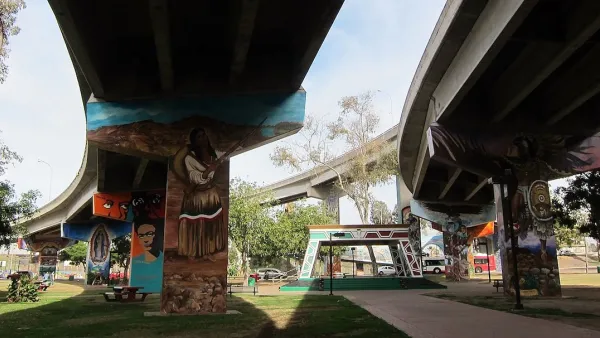
Opinion: Enhancing Inclusive Development: The Crucial Role of the Creative Class in Urban Planning
How bringing local artists into the development process can foster more vibrant, equitable neighborhoods.
How the National Park Service Uses GIS
A new book demonstrates how the National Park Service uses GIS technology to meet its mission and showcases a selection of maps used for effectively managing national parks.

Planetizen Federal Action Tracker
A weekly monitor of how Trump’s orders and actions are impacting planners and planning in America.

Chicago breaks ground on $3 billion megadevelopment
The new neighborhood, titled Foundry Park, will one day host 3,700 residences.

This MA town is drowning in its own sewage — and residents like it that way
Susan Murcott, a waste water expert, said if Carlisle didn't address their leaking sewage, the problem could turn “deadly.”

Iowa taxpayers are paying thousands to clean manure out of their water
While the Clean Water Act makes states responsible for regulating factory farms that discharge pollutants, Iowa has turned a blind eye to the polluting farms.

Amtrak cuts ribbon on Seattle Airo maintenance facility
The $250 million, nearly 100,000-square-foot building can house an entire Cascades Airo trainset.

To power data centers, Google seeks autonomous control of thousands of homes’ electricity
The tech company has signed a deal to indirectly pay Mid-Atlantic residents to reduce their power demand when the grid is strained.

FREE Course: Walkable City 1: Why Walkability?
After describing his path towards focusing on walkability as the essence of good planning, Jeff Speck marches through his five principal reasons for making more walkable places.
Reinventing Malls: Planning Alchemy—Turning Gray Fields Into Gold
The course focuses on the opportunities and imperatives that shape reinvention of mall sites.

City of Rosemead
Rutgers University, Edward J. Bloustein School of Planning and Public Policy
One Hundred Miles
The Architects Foundation
University of Cincinnati Online
Montrose County
The Pocatello Development Authority
The Urban Renewal Agency of the City of Pocatello