The decline of the 9 to 5 business district and changing corporate culture have landlords and tenants clamoring "to make their offices less square" and architects and planners eager to help transform conventional office spaces.


"Cutting out chunks of an office building's interior to create an atrium or theater, adding loft-like mezzanines on floors with high ceilings or grafting on outdoor staircases" are examples of the "more compact, playful designs" landlords will need to introduce into conventional office spaces to meet the changing tastes of Corporate America, observes Roger Vincent.
"Big changes in conventional offices are eventually going to be needed because formal workplaces where men and women arrive 'dressed for success' in tailored suits after long drives from suburbia are dying out, said Peter Miscovich, managing director of strategy and innovation and real estate brokerage Jones Lang LaSalle."
"The 1980s work-style model and lifestyle model is over," he said. "I don't think people enjoy commuting two hours each way every day. Young people in particular do not want to sacrifice their lifestyle for their work style."
Read the full story: Big changes are coming to conventional office buildings

Los Angeles just elected an urban planner as its mayor
Transportation analysts are optimistic that Raman will be more aggressive in addressing transit issues than Bass.
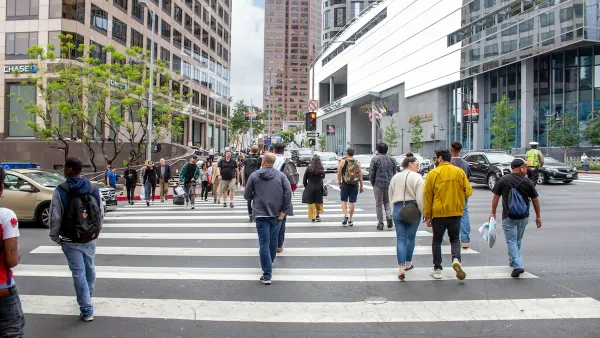
LA residents may be allowed to paint their own crosswalks
Councilwoman Katy Yaroslavsky put out a motion instructing the Los Angeles Department of Public Transportation to study the feasibility of allowing volunteers to paint crosswalks.
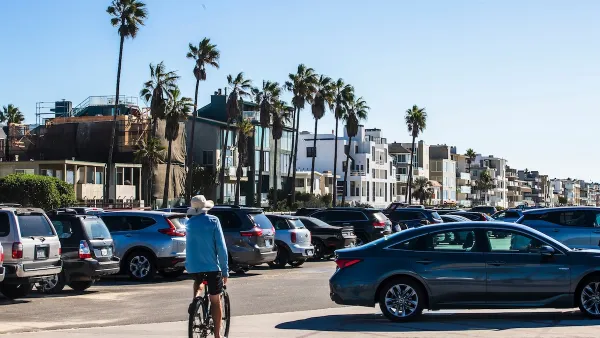
Not in my parking spot: LA renters oppose ADU development in their garages
Some tenants advocates say taking away residents’ parking spaces harms senior citizens and people with disabilities who rely on their cars to navigate the city.

Planetizen Federal Action Tracker
A weekly monitor of how Trump’s orders and actions are impacting planners and planning in America.

California plans to bury El Niño’s downpour
If the state plays its cards right, it may be able to store a billion acre-feet of El Niño’s water in aquifers.

Desperate measures: Advocates weigh draining Lake Powell to fill Colorado River
Draining the reservoir could reduce evaporation losses by a couple hundred thousand acre-feet.

Housing is the top priority of Seattle’s sole new councilmember
Jenks campaigned on building 1,000 new units of affordable housing.

New tax cuts may slash $1.5 billion in funding for Miami transit, public parks
Amendment 3 will save Miami-Dade homeowners $2,700 in 2028.

Arizona, Wisconsin, Pennsylvania hope to finally advance climate goals post-midterms
The three states have spent years under Republican or divided control.

FREE Course: Walkable City 1: Why Walkability?
After describing his path towards focusing on walkability as the essence of good planning, Jeff Speck marches through his five principal reasons for making more walkable places.
Reinventing Malls: Planning Alchemy—Turning Gray Fields Into Gold
The course focuses on the opportunities and imperatives that shape reinvention of mall sites.

City of Rosemead
Rutgers University, Edward J. Bloustein School of Planning and Public Policy
One Hundred Miles
University of Michigan School for Environment and Sustainability (SEAS)
Hunter College, City University of New York (CUNY)
The Architects Foundation
City of Cambridge
Montrose County
The Pocatello Development Authority