All of that Congressional gridlock seems to be causing a lot of accidents. For the sixth year in a row, Washington D.C.'s drivers have come in last place in Allstate’s annual "America’s Best Drivers" report.


The average American gets into an auto accident once every 10 years. But if that's too long of an interval for you, we'd suggest relocating to the Nation's Capital.
"Drivers in Washington, D.C. are more than twice as likely to get into traffic accidents than the national average, according to a new report, making residents of the nation’s capital the worst drivers in the country," reports Reid Wilson. "Washington residents go an average of just 4.8 years between accidents, according to Allstate’s America’s Best Drivers report."
“I wouldn’t say it’s the worst, I’d say it’s the least best,” Adam Polak, an Allstate spokesman based in Arlington, said of Washington. “From looking at our data, drivers in Washington, D.C. on average have collisions more frequently.”
"Motorists in Fort Collins, Colo., are the safest in the nation, according to the report, going an average of 13.9 years between accidents," adds Wilson.
Read the full story: All your suspicions confirmed: Washington has nation’s worst drivers

Let’s End Traffic Stops
The technology to make traffic enforcement obsolete is becoming available. But in the U.S. willing to use it?
New USDOT safety strategy highlights enforcement, embraces autonomous cars
The new National Roadway Safety Strategy emphasizes safety technology and enforcement and promises to further crack down on immigrant truck drivers with illicitly obtained licenses.
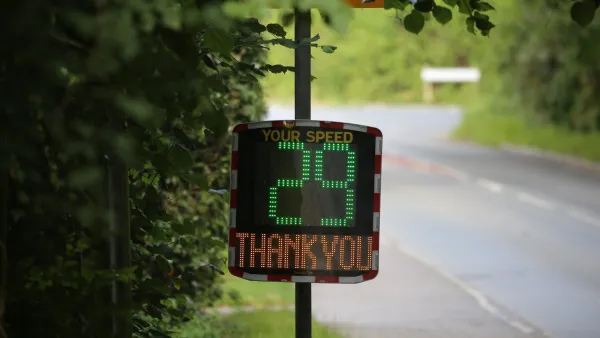
Austin road sign compliments safe drivers
An electronic display praises drivers who stay under the speed limit with personalized messages.

Washington state to charge fee to drivers with fuel-efficient cars
Revenue from the fee will go towards supporting the state’s highways.

Illinois considers spending $1 billion in taxpayer money on data center
A quantum computing campus and data center are currently under construction in Chicago.

Trump to blast ‘hydrocarbon highway’ through ‘world’s longest art gallery’
Environmental and historic preservation groups are suing to stop the project.

NYC, state sue feds over mixed-immigration-status housing assistance rule
The state’s lawsuit argues that the rule change violates the Administrative Procedure Act.

Michigan to turn neighborhood into virtual power plant
Residents will soon be able to divert their excess energy to the grid in exchange for compensation.

Data center, mining project swarm to long-awaited Alaska railroad line
The state-owned railroad approved final plans for the spur line this week; the project is expected to cost $311 million, mostly funded by the federal government

FREE Course: Walkable City 1: Why Walkability?
After describing his path towards focusing on walkability as the essence of good planning, Jeff Speck marches through his five principal reasons for making more walkable places.
Reinventing Malls: Planning Alchemy—Turning Gray Fields Into Gold
The course focuses on the opportunities and imperatives that shape reinvention of mall sites.

City of Charlotte
City of Rosemead
Rutgers University, Edward J. Bloustein School of Planning and Public Policy
University of Michigan School for Environment and Sustainability (SEAS)
Hunter College, City University of New York (CUNY)
The Architects Foundation
University District Partnership