Lac-Mégantic, Quebec was the site of a train derailment that cost dozens of lives and destroyed 10 blocks of its downtown. Now residents and town leaders are working to heal from that tragic event with plans for the future.


"'You’ve got to recapture the whole sense of the city,' says John van Nostrand, a Toronto architect and urban planner with international experience working in disaster-riddled communities. 'It's partly about nostalgia, but it’s partly the opportunity to change it. … You need good streets, you need public space, and you need a good layout – but you also need a place that allows people to remake it the way they’d like to see it.'"
"Just as people don’t suffer or recover from trauma the exact same way, no two towns emerge from disaster with the same scars or plans for renewal," writes Kathryn Blaze Carlson. "But both Cordova and Lac-Mégantic are in the rare (if deeply unenviable) position to build their centres from scratch, to lay the groundwork for a 'destination' rather than a cookie-cutter 'non-place' lacking the natural energy that pulses from established communities but is so rarely found in overly built environments."
Read the full story: How rebuilding plans will create a new vision of Lac-Mégantic
Lac-Mégantic One Year Later
July 6, 2014 marks the one-year anniversary of North America's most catastrophic energy calamity when a runaway oil unit train carrying Bakken crude exploded in this small Quebec town killing 47 people and incinerating ten blocks of its downtown.
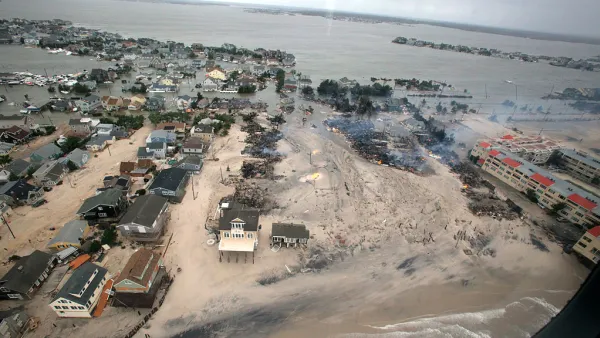
The Era of “When, Not If,” Compels a New Approach to Waterfront Development
On the anniversary of Hurricane Sandy, ULI offers guidance on post-disaster rebuilding and building in anticipation of future disasters in a way that helps preserve the environment, boost economic prosperity, and foster a high quality of life.
Earl Blumenauer on America's Unwise Approach to Disaster Planning and Recovery
Oregon Congressman Earl Blumenauer talks about the failures with federal natural disaster relief and how the country should build its resiliency to climate change with The Planning Report.

Planetizen Federal Action Tracker
A weekly monitor of how Trump’s orders and actions are impacting planners and planning in America.

Eastern Nebraska is running out of electricity
Data centers and electrification are straining eastern Nebraska’s grid, throttling economic development.

Move over, LA: St. Louis gears up for Olympics, invests millions in downtown redevelopment
The Missouri city will host the 2028 Olympic soccer group stage and knockout matches.

Dallas releases zoning code overhaul to officials
The drafted overhaul is over 400 pages long.

NYC renovations for dangerous, ‘mercilessly crammed’ street delayed until 2027
Construction was supposed to begin this fall.

San Diego’s Midway Rising project gets greenlight from city council
The project looks to become the largest affordable housing development in California's history.

FREE Course: Walkable City 1: Why Walkability?
After describing his path towards focusing on walkability as the essence of good planning, Jeff Speck marches through his five principal reasons for making more walkable places.
Reinventing Malls: Planning Alchemy—Turning Gray Fields Into Gold
The course focuses on the opportunities and imperatives that shape reinvention of mall sites.

City of Rosemead
Rutgers University, Edward J. Bloustein School of Planning and Public Policy
One Hundred Miles
University of Michigan School for Environment and Sustainability (SEAS)
Hunter College, City University of New York (CUNY)
The Architects Foundation
City of Cambridge
The Pocatello Development Authority
The Urban Renewal Agency of the City of Pocatello