Britain's grand plan to halve travel times between the country's biggest cities and expand economic growth outside London via high-speed rail is getting pushback from the very places it's meant to help.


"A proposed high-speed railroad known as HS2 is Britain’s biggest and most controversial transportation plan, a Continental-style 'grand projet' meant to ease crowded trains and congested tracks, reduce automobile traffic and generate economic growth," writes Stephen Castle.
"Yet as cost estimates have risen — the budget now stands at £42.6 billion, or $65.8 billion — so has opposition to the project. And some of the strongest resistance comes from the very parts of the north that HS2 is supposed to help."
For instance, Peter Box, leader of Wakefield Council, "argues that highway repairs and upgraded regional rail links should be higher priorities than HS2, which he worries may mainly benefit the south. Instead of attracting investment and talent to the northern regions, he said, HS2 may simply funnel more people and prosperity into London."
"Some critics agree, noting that when Japan and South Korea built their high-speed rail systems, the economic gap between those countries’ capitals and outlying cities widened," notes Castle.
Read the full story: As Cost of U.K. Rail Project Grows, So Does Resistance
Route for England's New High-Speed Rail Line Unveiled
This week, the UK government announced the controversial route for phase 2 of "the first major railway line north of London since Victorian times." The line, dubbed HS2, will halve journey times between northern cities and to the capital.

California High-Speed Rail Authority picks trainset manufacturer
The California High-Speed Rail Authority aims to start servicing passengers by 2033.
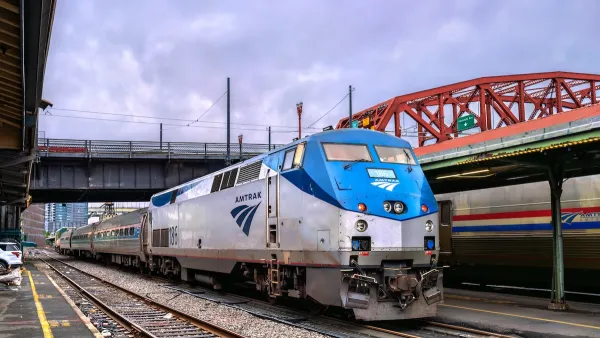
Transit leaders progress high-speed rail from Portland to Vancouver, B.C.
Washington state officials may reveal feasible routes for the high-speed rail in late 2027.

Planetizen Federal Action Tracker
A weekly monitor of how Trump’s orders and actions are impacting planners and planning in America.

Eastern Nebraska is running out of electricity
Data centers and electrification are straining eastern Nebraska’s grid, throttling economic development.

Study reveals best places in the U.S. for cycling, walking
New research from Streetlight Data examines bicycle and pedestrian miles per capita in the 100 largest U.S. cities by population.

All sides of BRT debate unhappy with CDOT’s most recent move
The Colorado Department of Transportation is no longer considering center-running bus lanes for Colorado Boulevard.

Massachusetts bogs generate both power, and cranberries
Putting solar panels above farmland is one way Massachusetts is advancing toward its goal of net-zero carbon emissions by 2050.

What could the future of LA transit look like under Raman?
The mayor-elect views broken sidewalks and potholes as crises that can be fixed with better governance.

FREE Course: Walkable City 1: Why Walkability?
After describing his path towards focusing on walkability as the essence of good planning, Jeff Speck marches through his five principal reasons for making more walkable places.
Reinventing Malls: Planning Alchemy—Turning Gray Fields Into Gold
The course focuses on the opportunities and imperatives that shape reinvention of mall sites.

City of Rosemead
Rutgers University, Edward J. Bloustein School of Planning and Public Policy
One Hundred Miles
University of Michigan School for Environment and Sustainability (SEAS)
Hunter College, City University of New York (CUNY)
The Architects Foundation
City of Cambridge
The Pocatello Development Authority
The Urban Renewal Agency of the City of Pocatello