New data supports Paul Krugman's contention that sprawl inhibits the American Dream.


"The Equality of Opportunity Project’s recent study of intergenerational mobility showed a marked division between areas of the country with high vs. low mobility rates. Although their study was not a place-based analysis, there seemed to be a clear spatial pattern across the US. Paul Krugman postulated that there was some relationship with suburban sprawl – i.e., that sprawl was somehow to blame for low social mobility. The idea is that being poor in a non-accessible neighborhood accentuates the jobs-housing mismatch and compounds the difficulty for low-income households to access jobs and experience income mobility," write Emily Talen and Julia Koschinsky.
"To look more closely at the possible connection between mobility and sprawl, we compared the mobility rates used in the study to a measure of neighborhood access. We hypothesized that places with low mobility would correlate with places with low accessibility. We used low accessibility – based on distance to amenities like grocery stores, retail and schools – as a proxy for suburban sprawl. Our results lend support to Dr. Krugman’s hypothesis."
Read the full story: Intergenerational mobility vs. sprawl: Is there a connection?
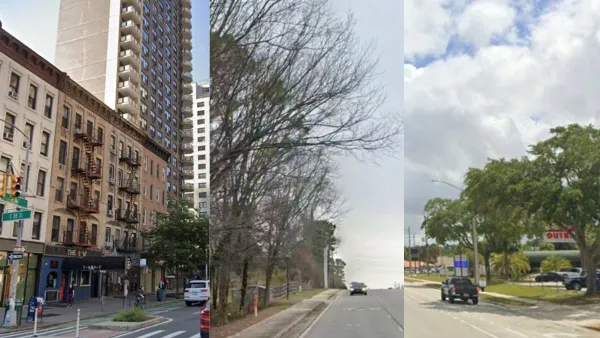
A Transect of sprawl
A development pattern this lifestyle-defining deserves its whole own classification system.

The Natalist Case For Sprawl (And Why It Fails)
Some commentators defend anti-urban government policies such as exclusionary zoning on the basis that homeowning suburbanites have high birth rates. But this doesn't seem to be true in recent decades.

Density and Disorder: The Imaginary Link
A recent article tries to tie public transit and walkability to social disorder — but in fact, sprawling Sunbelt cities like Memphis are as likely to have high crime rates as transit-rich metropolises such as New York and San Francisco.

Planetizen Federal Action Tracker
A weekly monitor of how Trump’s orders and actions are impacting planners and planning in America.

California plans to bury El Niño’s downpour
If the state plays its cards right, it may be able to store a billion acre-feet of El Niño’s water in aquifers.

Desperate measures: Advocates weigh draining Lake Powell to fill Colorado River
Draining the reservoir could reduce evaporation losses by a couple hundred thousand acre-feet.

In Texas, data centers are swallowing promised parkland
Residents who moved to Taylor, Texas for a rural community now have to contend with three data centers in their backyard.

How a Chicago-sized wind farm beat the odds and powered on
The project spanned five presidential administrations and a standoff with a U.S. military base.

MTA gives itself 30 days to transform pit into basketball court
The site has been under construction since 2022; the city originally estimated it would finish the court in 2024.

FREE Course: Walkable City 1: Why Walkability?
After describing his path towards focusing on walkability as the essence of good planning, Jeff Speck marches through his five principal reasons for making more walkable places.
Reinventing Malls: Planning Alchemy—Turning Gray Fields Into Gold
The course focuses on the opportunities and imperatives that shape reinvention of mall sites.

City of Rosemead
Rutgers University, Edward J. Bloustein School of Planning and Public Policy
One Hundred Miles
Hunter College, City University of New York (CUNY)
The Architects Foundation
University of Cincinnati Online
City of Cambridge
Montrose County
The Pocatello Development Authority