Flush with revenue from higher gas taxes, Maryland is moving ahead with plans for a 16-mile light rail line connecting the state's dense D.C. suburbs. It's seeking a private partner to help it construct and operate the planned Purple Line.


"Maryland will seek a private company to build and operate a planned $2.2 billion light-rail Purple Line, marking the first time the state has used such financing on a public transit project," reports John Wagner. "With the Purple Line, Maryland is seeking a single private partner to design, construct, operate and maintain the project. In return, the state plans to offer annual payments throughout a 30- to 40-year contract period. Deductions would be made from the payments if the operator falls short on standards such as on-time performance, cleanliness and customer service, according to transportation officials."
"Maryland officials are counting on the federal government to cover about $900 million of the project’s construction cost and will look for contributions from local governments and the private sector as well, said Erin Henson, a spokeswoman for the Department of Transportation. Construction could begin as early as 2015."
"Maryland and other states increasingly are turning to public-private partnerships to create more flexibility in financing and construction of large-scale projects at a time when government resources are limited," adds Wagner.
Read the full story: Maryland to seek private firm for Purple Line project
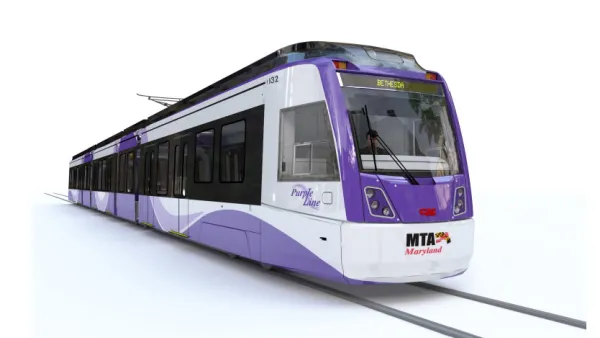
Preserving Affordable Housing Along Maryland Light Rail Line
A new plan lays out strategies to keep housing affordable for low- and moderate-income residents along the corridor of Maryland’s new Purple Line.
DC Metro Is Betting on Buses
The agency plans to significantly expand bus service, which can be added faster and at a lower cost than rail projects.
DC Suburban Light Rail Expansion Prompts Mixed-Use Development
The Purple Line’s expansion into Maryland suburbs in 2027 has spurred TOD along the line.

Planetizen Federal Action Tracker
A weekly monitor of how Trump’s orders and actions are impacting planners and planning in America.

California plans to bury El Niño’s downpour
If the state plays its cards right, it may be able to store a billion acre-feet of El Niño’s water in aquifers.

Desperate measures: Advocates weigh draining Lake Powell to fill Colorado River
Draining the reservoir could reduce evaporation losses by a couple hundred thousand acre-feet.

Housing is the top priority of Seattle’s sole new councilmember
Jenks campaigned on building 1,000 new units of affordable housing.

New tax cuts may slash $1.5 billion in funding for Miami transit, public parks
Amendment 3 will save Miami-Dade homeowners $2,700 in 2028.

Arizona, Wisconsin, Pennsylvania hope to finally advance climate goals post-midterms
The three states have spent years under Republican or divided control.

FREE Course: Walkable City 1: Why Walkability?
After describing his path towards focusing on walkability as the essence of good planning, Jeff Speck marches through his five principal reasons for making more walkable places.
Reinventing Malls: Planning Alchemy—Turning Gray Fields Into Gold
The course focuses on the opportunities and imperatives that shape reinvention of mall sites.

City of Rosemead
Rutgers University, Edward J. Bloustein School of Planning and Public Policy
One Hundred Miles
University of Michigan School for Environment and Sustainability (SEAS)
Hunter College, City University of New York (CUNY)
The Architects Foundation
City of Cambridge
Montrose County
The Pocatello Development Authority