After a long confirmation delay, Gina McCarthy, the new head of the U.S. Environmental Protections Agency, has wasted little time wading into the controversy over the agency's (and administration's) role in addressing climate change.


"The new head of the Environmental Protection Agency told an audience at Harvard Law School on Tuesday that cutting carbon pollution will 'feed the economic agenda of this country' and vowed to work with industry leaders on shaping policies aimed at curbing global warming," reports Juliet Eilperin. "McCarthy made a full-throated defense of her agency’s right to address greenhouse-gas emissions and other pollutants, saying that air-quality regulations and environmental cleanup efforts have already produced economic benefits in the United States."
“Can we stop talking about environmental regulations killing jobs, please?” she asked, prompting loud applause. “We need to embrace cutting-edge technology as a way to spark business innovation.”
"[McCarthy] said climate change was now the top priority for the agency," adds Eilperin, "which plans to model its efforts on the administration’s earlier agreement with the auto industry on stricter fuel efficiency standards for cars and light trucks."
Read the full story: As new EPA chief, Gina McCarthy vows to act on climate change


Op-Ed: Obama's Weak Climate Change Legacy
David Bookbinder argues that the Obama Administration dragged its feet on climate change, only implementing last-minute actions that will be easy to reverse.
Momentous Climate Plan Being Development by Obama
An historic plan to limit greenhouse gas emissions is being covertly developed by the Obama administration, reports Neela Banerjee. The plan could for the first time set limits on the country's biggest emitters: power plants.
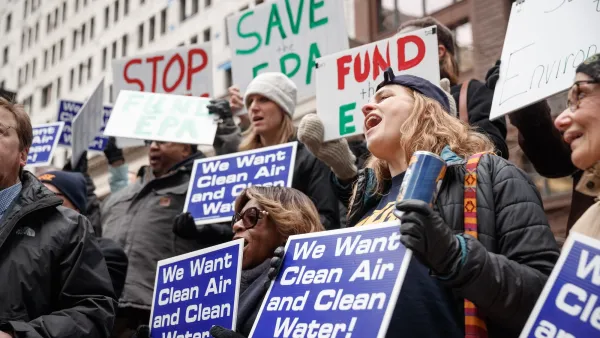
EPA Guts Emissions Regulations
The agency is eliminating the endangerment finding that underpins the agency’s authority to regulate greenhouse gas emissions.

Planetizen Federal Action Tracker
A weekly monitor of how Trump’s orders and actions are impacting planners and planning in America.

HUD modernizes 50-year-old manufactured housing framework
The Next Generation Manufactured Housing Action Plan establishes new energy-efficiency standards for manufactured homes, and new guidelines for anchoring them.

Data reveals that NYC’s bet on congestion pricing has paid off
After almost two years of the program, reports show positive impacts on traffic and air quality and no disruptions to parking.

How Chicago, New York and Seattle are funding transit projects amid tough times
Notes from the American Public Transportation Association's TransForm conference in Chicago.

Transport for London tackles hate crime spike with free bystander training
Recorded hate crime offences on the London's transport network have increased by 36 per cent.

Denver is solving homelessness. Why aren't the rest of us?
Since 2023, Denver's street homeless population has decreased by 64%, proving that effective tools exist to support those in need of housing.

FREE Course: Walkable City 1: Why Walkability?
After describing his path towards focusing on walkability as the essence of good planning, Jeff Speck marches through his five principal reasons for making more walkable places.
Reinventing Malls: Planning Alchemy—Turning Gray Fields Into Gold
The course focuses on the opportunities and imperatives that shape reinvention of mall sites.

One Hundred Miles
County of Mendocino
planning NEXT
The Architects Foundation
University of Cincinnati Online
Montrose County
Northern Illinois Transit Authority (NITA)
The Pocatello Development Authority