A pop-up park in Williamsburg has brought bike tracks, an urban farm, an outdoor 'reading room', and other amenities to Brooklyn's historically industrial waterfront. Can the temporary oasis bring lasting change to its users?


Sarah Goodyear tours Havemeyer Park, "a one-year pop-up installation that takes up half a city block near the old Domino Sugar factory on the Brooklyn waterfront." The park is the product of a unique collaboration between bike track designer Jim Dellavalle, event company Bobby Redd, and developer Two Trees, who will soon transform the site into a 3.3-million-square-foot mixed-use project.
"The lot that is now, briefly, Havemeyer Park includes not only Dellavalle’s ingenious and compact bike paradise, known officially as Brooklyn Bike Park, but also an urban farm run by North Brooklyn Farms, a lawn for movie screenings, yoga classes, and music, and what Dellavalle calls 'the reading room' – a placid green space surrounded by flowers where people will be able to choose from donated books (1,000 so far) and relax as they flip the pages," explains Goodyear. "There will also be food served from shipping containers and a deck to eat on," she adds.
Though the park's life will be short lived, Dellavalle has lofty aims for it. “The bike park method is about a few things,” he says. “Social awareness. Physical education. Environmental education. And socialism, straight up. There’s a work ethic. You’ve got to dig to ride, you’ve got to volunteer some time.”
"What’s he’s really trying to build, he tells me, is a culture, a way of approaching life that starts with biking and goes through stormwater management, and who knows where it ends?"
Read the full story: This Might Be the Most Impressive Pop-Up Park We've Ever Seen

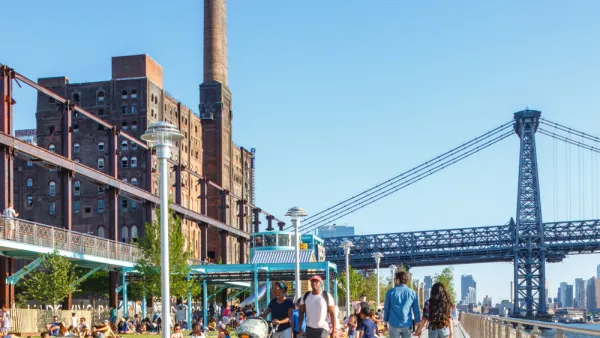
Splashy New Project Revealed for the Williamsburg, Brooklyn Waterfront
A skyline-changing pair of towers are proposed for for the Williamsburg waterfront in Brooklyn.
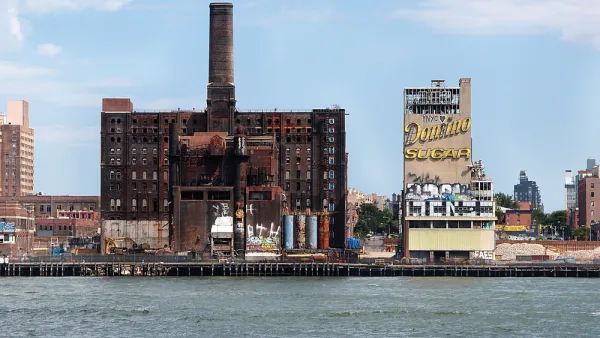
Domino Sugar Redevelopment Granted Catalytic Status on Williamsburg Waterfront
Crain's New York Business surveys the development investments that have followed the Domino Sugar Refinery redevelopment to the Williamsburg waterfront.
Refined Plans Unveiled for Brooklyn's Domino Sugar Site
Alan G. Brake outlines the redesigned plans to develop the site of the historic Domino Sugar refinery along Brooklyn's East River waterfront. The $1.5 billion plan is the latest, and perhaps last, turn in the site's tortured redevelopment saga.

Planetizen Federal Action Tracker
A weekly monitor of how Trump’s orders and actions are impacting planners and planning in America.

Amtrak, CN end decades-long dispute with eight-year agreement
The new operating agreement establishes an updated framework for the companies to work together, including processes to resolve disputes.

Judges permit Denver to divert 77,000 acre feet from the Colorado River for reservoir expansion
Overuse and climate change have caused the Colorado River’s water levels to plummet.

NYC DOT wants faster, more permanent street upgrades
The city is examining ways to build more concrete infrastructure without getting entangled in 'decades-long' projects.

'Something we’ve never seen before:' rising utility rates could strain city finances nationwide
Data centers, climate change and other factors have caused utility rates in the United States to increase by 38% since 2020.

Trump to overrule local leaders, lease millions of acres of America’s Pacific Island territories’ seafloors to mining companies
International law says that the Indigenous people of America’s territories have a right to prior and informed consent regarding projects that impact their countries.

FREE Course: Walkable City 1: Why Walkability?
After describing his path towards focusing on walkability as the essence of good planning, Jeff Speck marches through his five principal reasons for making more walkable places.
Reinventing Malls: Planning Alchemy—Turning Gray Fields Into Gold
The course focuses on the opportunities and imperatives that shape reinvention of mall sites.

Harvard University Graduate School of Design
KFH Group Inc.
Greater Baltimore Committee
The Architects Foundation
University of Cincinnati Online
The Pocatello Development Authority
The Urban Renewal Agency of the City of Pocatello