Last month an innovative real-time bike counter debuted along San Francisco's Market Street, which is said to be the busiest bike street west of the Mississippi. Over its first 27 days, the counter tallied nearly 55,000 riders.


"Just glance at the steady flow of cyclists cruising along downtown San Francisco’s major thoroughfare Market Street at rush hour, and you’ll get the sense that the bike lanes are being well utilized," writes Zak Stone. "But observations aren’t the same as cold, hard data, and the city has installed a new bike counter that visualizes just how much the number of bikers has grown, joining cities like Seattle and Copenhagen who have taken on similar awareness-raising projects."
See this Streetsblog article published the day after its debut for an image of the counter in action.
“The installation of this innovative bicycle barometer comes at a critical moment in San Francisco,” the SFMTA Director Ed Reiskin said in a statement. “As more and more San Franciscans are using a bicycle as part of their everyday commute, this visual bike counter will raise awareness of the positive impact bicycling has on traffic congestion, air quality and personal health.”
Read the full story: A Live Bike Counter Shows A City How Many People Are Riding

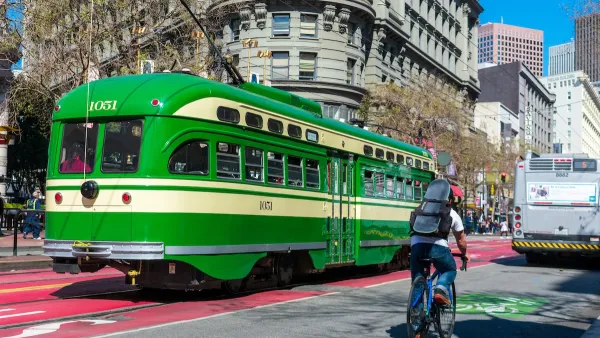
SF’s Market Street Will no Longer be Car-free
The city will allow Waymo robotaxis and ride-hailing app vehicles to drive down the car-free stretch of Market Street as part of Mayor Dan Lurie’s effort to help revitalize local businesses.
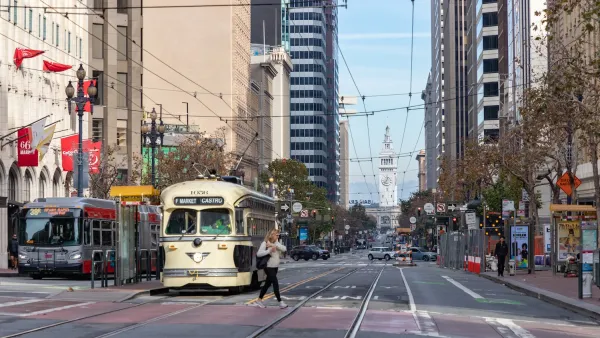
Waymo Gets Permission to Map SF’s Market Street
If allowed to operate on the traffic-restricted street, Waymo’s autonomous taxis would have a leg up over ride-hailing competitors — and counter the city’s efforts to grow bike and pedestrian on the thoroughfare.
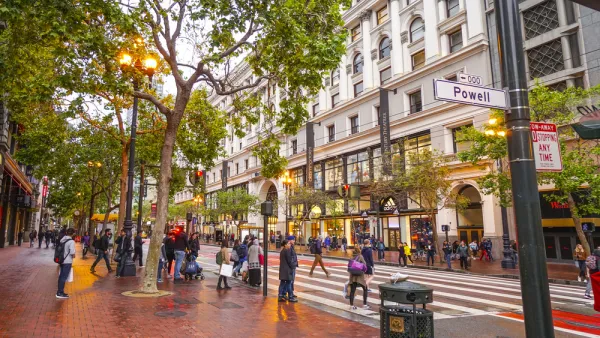
Car-Free Streets Aren't a Silver Bullet
The San Francisco Chronicle's urban design critic tempers expectations for Market Street in San Francisco, where the city this week undertook an ambitious, but perhaps over-sold, redesign of the busy street.

Planetizen Federal Action Tracker
A weekly monitor of how Trump’s orders and actions are impacting planners and planning in America.

Northwest rail fans eager for Sept. 30 debut of Amtrak’s Airo fleet
Get ready for that new train smell and more seats. But they won’t go faster or run more frequently on the Cascades route in Washington and Oregon.
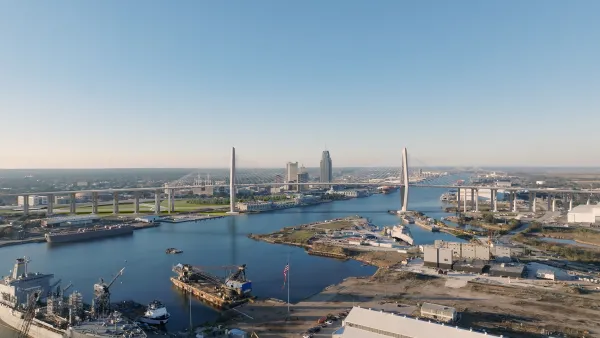
Alabama scores up to $2.5 billion federal loan for largest infrastructure project in state’s history
The Mobile River Bridge and Bayway Project aims to ease congestion at Alabama’s worst bottleneck.

Novel study finds extreme state-by-state disparity in housing construction timelines
The first comprehensive working paper on U.S. construction timelines also found that the permitting process for multi-family projects has slowed nationwide.

California may destroy its beaches trying to save homes from El Niño
Boulders and seawalls can protect homes from waves, but ultimately destroy sandy beaches.

California high-speed rail accomplishes only one legislative goal in 2026
The majority of the agency's failed pitches were never developed into written proposals.

FREE Course: Walkable City 1: Why Walkability?
After describing his path towards focusing on walkability as the essence of good planning, Jeff Speck marches through his five principal reasons for making more walkable places.
Reinventing Malls: Planning Alchemy—Turning Gray Fields Into Gold
The course focuses on the opportunities and imperatives that shape reinvention of mall sites.

City of Thousand Oaks
City of Wisconsin Rapids
Harvard University Graduate School of Design
The Architects Foundation
University of Cincinnati Online
Northern Illinois Transit Authority (NITA)
The Pocatello Development Authority
The Urban Renewal Agency of the City of Pocatello