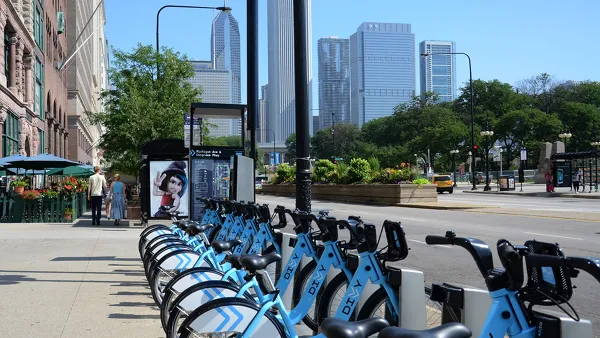
Not to be outdone by its big (and small) city brethren, the nation's third largest city is launching its long-awaited, and relatively secretive, bike-sharing program next month. And according to Paul Merrion, they're starting with a bang.


"Call it the big bang theory of bicycling," says Merrion. "While New York had a map of bike station locations and a website signing up users for months before its system went live on Memorial Day, Chicago plans to compress that public prelude down to about two weeks."
"By mid-June, the first 75 solar-powered kiosks will be installed and the city will start renting some 750 bikes, with 300 stations and 3,000 bikes available by the end of this summer, expanding to 400 sites and 4,000 bikes by next summer."
"New York saw protests and at least one lawsuit from condo owners and businesses after they found out where bike stations were going," notes Merrion. "Chicago has avoided that kind of controversy by keeping details under wraps, but now there could be potholes ahead."
“'We're going to launch this thing all at once,' said Sean Wiedel, assistant commissioner for transportation and the city's point man for the program, dubbed 'Divvy.'"
True to their word, the city opened registration for "founding" memberships today at noon, and released a map of the planned station locations for each of the program's five initial phases of implementation.
Read the full story: Bike-sharing starts with a bang


Chicago to Add or Upgrade 200 Bike Share Stations
The Divvy bike share system saw its highest ridership ever in 2025 with 6.8 million trips.

Divvy Introduces E-Bike Charging Docks
New, circular docks let e-bikes charge at stations, eliminating the need for frequent battery swaps.
Chicago Bike Share Expands Citywide
Divvy is now available in all 50 wards, with more stations and bikes planned for the system in the next two years.

Planetizen Federal Action Tracker
A weekly monitor of how Trump’s orders and actions are impacting planners and planning in America.

California plans to bury El Niño’s downpour
If the state plays its cards right, it may be able to store a billion acre-feet of El Niño’s water in aquifers.

Chicago breaks ground on $3 billion megadevelopment
The new neighborhood, titled Foundry Park, will one day host 3,700 residences.

California High-Speed Rail Authority CEO resigns after $600,000 scandal
Under Ian Choudri, the authority used taxpayer dollars to fund first class flights and trips to nightclubs.

Want to study the Missouri River? Soon, you may need unanimous approval from 10 states
Legislation would require 10 governors’ permission to study or build projects moving water outside the basin.

Desperate measures: Advocates weigh draining Lake Powell to fill Colorado River
Draining the reservoir could reduce evaporation losses by a couple hundred thousand acre-feet.

FREE Course: Walkable City 1: Why Walkability?
After describing his path towards focusing on walkability as the essence of good planning, Jeff Speck marches through his five principal reasons for making more walkable places.
Reinventing Malls: Planning Alchemy—Turning Gray Fields Into Gold
The course focuses on the opportunities and imperatives that shape reinvention of mall sites.

City of Rosemead
Rutgers University, Edward J. Bloustein School of Planning and Public Policy
One Hundred Miles
Hunter College, City University of New York (CUNY)
The Architects Foundation
University of Cincinnati Online
City of Cambridge
Montrose County
The Pocatello Development Authority