Congress has an Animal Protection Caucus, a Hockey Caucus, and a Kidney Caucus, so it's about time the millions of Americans who rely on public transit for their daily transportation needs had a voice in D.C.


"A bipartisan pair of lawmakers in the House announced on Thursday that they were forming a caucus for public transportation supporters," reports Keith Laing. "The lawmakers, Rep. Daniel Lipinski (D-Ill.) and Michael Grimm (R-N.Y.), said the caucus would 'provide a forum for members of Congress to engage in constructive dialogue on the challenges and needs of mass transit agencies across the country.'"
“Buses, trains, and light rail that run safely and reliably reduce congestion on our roads, improve travel times across all modes, cut down on air pollution, and make our communities more attractive places to live, work, and own businesses,” Lipinski said in a statement. “Maintaining and improving our public transportation systems must be a part of the solution to creating jobs at home and ensuring our competitiveness in the global marketplace," he continued.
Read the full story: Lawmakers form public transit caucus

Congress Introduces Bill to Limit Size of SUVs and Trucks
Lawmakers want the federal government to set standards for vehicle height and visibility to combat the sharp rise in pedestrian deaths over the past decade.

Undoing Biden's EV Rule
The partisan divide over how government should reduce greenhouse gas emissions was on full display after the Biden administration finalized its emissions standards rule for light and medium duty vehicles on March 20.
Brookings: A Demographic Post-Mortem of the Midterms
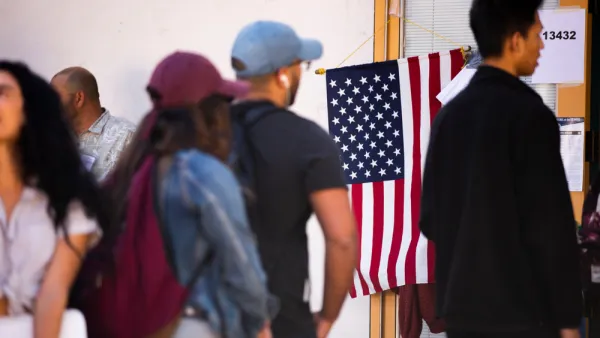
Young adults, according to a deep dive analysis by Brookings Metro demographer William Frey, were a key demographic group responsible for stopping the red wave that most polling predicted as the likely outcome of last month's midterm elections.

Desperate measures: Advocates weigh draining Lake Powell to fill Colorado River
Draining the reservoir could reduce evaporation losses by a couple hundred thousand acre-feet.

Eastern Nebraska is running out of electricity
Data centers and electrification are straining eastern Nebraska’s grid, throttling economic development.

Malls are becoming the midtowns of the future
Mall and office park redevelopments are a generational opportunity to create new nodes of urbanity.

Officials claim feds 'rushed' Amtrak environmental review
Amtrak plans to move their Chicago maintenance facility from an industrial area to a residential one.

NYC breaks ground on anti-flooding infrastructure project
New York City's new system will reduce stormwater flows to local sewers by 90%.

One Kentucky town’s secret to affordable housing
The Smoketown Community Land Trust has already built seven affordable homes for community members.

FREE Course: Walkable City 1: Why Walkability?
After describing his path towards focusing on walkability as the essence of good planning, Jeff Speck marches through his five principal reasons for making more walkable places.
Reinventing Malls: Planning Alchemy—Turning Gray Fields Into Gold
The course focuses on the opportunities and imperatives that shape reinvention of mall sites.

City of Rosemead
Rutgers University, Edward J. Bloustein School of Planning and Public Policy
One Hundred Miles
University of Michigan School for Environment and Sustainability (SEAS)
Hunter College, City University of New York (CUNY)
The Architects Foundation
City of Cambridge
Montrose County
The Pocatello Development Authority